May 14, 2011
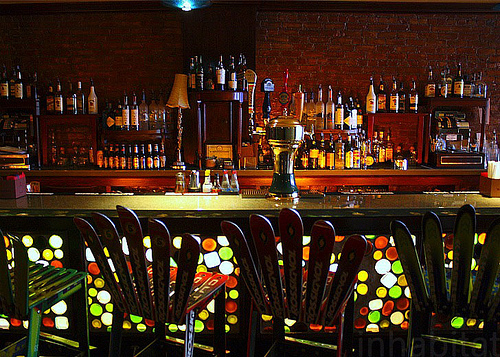
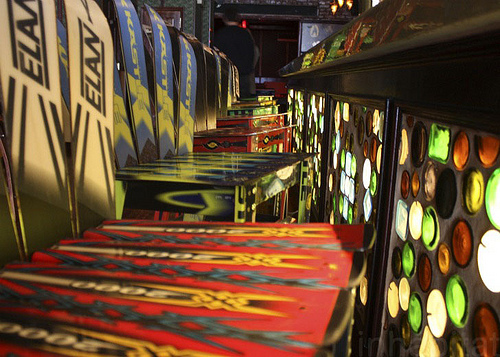
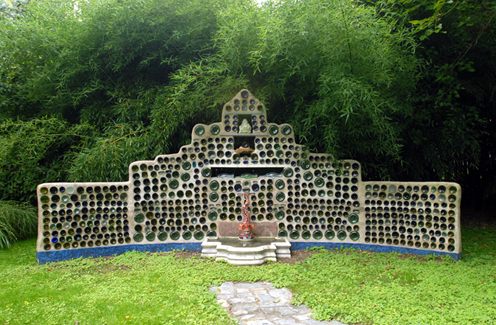
Bottle Wall Bar at Revision Lounge
The bottle wall makes it to Manhattan.
Revision Lounge, all made with recycled materials, including this bottle wall bar.
from Flickrite Inhabitat
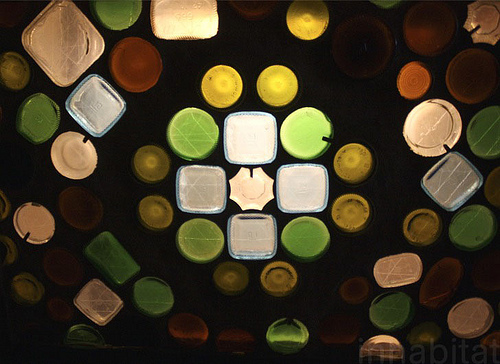
detail of bottle
April 13, 2011
Bottle Structures - Jackie Stack and Indonesia
I recently found a blog post about bottle houses from a 'green' blog called Pixie Gas. The post is called 'Don’t keep Your Enthusiasm About Reusing Bottled Up! 20 Bottle Structures', with several structures that I'd never heard of. Names are mentioned, but there are no links. Maddening.
There are 2 structures mentioned that I had heard of, and I have links!
One has to do with the work of Jackie Stack Lagakos, who has her own business building 'Bottle Structures'. Jackie contacted me a few months ago because she came across the original bottle wall post from 2007.
Some examples of Jackie's work -
Hotai Bottle Bench aka hip hop Buddha - 1998
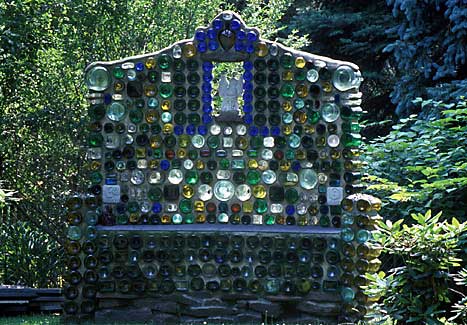
and a detail
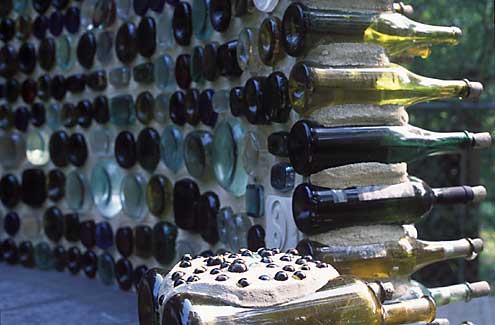
a more recent example
Last Stop For Miles And Trane - 2004
Jacki also teaches the occasional workshop and I asked her to let me know when she has any details on upcoming workshops.
The other example of a newer bottle structure is this Indonesian bottle house, designed and owned by architect Ridwan Kamil and done in a more '20th century modernist' style, with a very neat and tidy design.
February 16, 2011
Video of Bottle Village
German language video tour of Grandma Prisbrey's Bottle Village.
It is definitely worthwhile since you can hear some of the English tour guide and there are lots and lots of nice details shots.
It's part of a movie called American Daydream.
January 30, 2011
Rare Visions Online
Way back in my first ever post on Bottle Walls and Houses, I mentioned that I first heard about Bottle Houses from a TV series on outsider art. That TV show, Rare Visions and Roadside Revelations, finally has some full episodes online. How long the episodes will remain online, I'm not sure, but here is one embedded, with a link to more. This episode contains 2 bottle sites. One is the early Bottle house site in Ryholite, NV - the Tom Kelly House. Not much to see, but it's one of the most historically important since it's one of the most intact early bottle houses. The other bottle site, Thunder Mountain Monument, in Imlay NV, gives some juicy and tantalizing glimpses of very stained glassy bottle wall interiors. This segment is a good illustration of the kind of images I saw that made me start researching bottle walls and houses.
Open up the video in a window at this address -
http://cove.kcpt.org/video/1393283890
or see the embedded video below the fold.
Watch more episodes. Official website at Rare Visions and Roadside Revelations.
March 05, 2010
Argentinian Bottle House
Contemporary Bottle House Creator, said to have 6 million bottles involved?! The stained glassy shots don't start until about 1:35 into the 2:39 video.
February 27, 2010
Middle Eastern "Bottled Walls"
I'm not what you would call a fan of big explosion action movies, so the last thing I expected would be to post an image on this blog from "Transformers 2: Revenge of the Fallen". But, a few weeks ago, a movie blog called 'Incontention' did an entry on 'the top ten shots of 2009' and the first shot I saw included, of all things, a bottle wall!
This is the shot, here taken from a screenshot for the Transformers 2 trailer on YouTube. This shot in the trailer lasts only about 2 seconds. If you want to see the whole shot, forward to about 1:05 and wait for the 2 seconds at 1:15-1:17. That's the whole shot. I wouldn't bother with the rest of the trailer. Seriously.
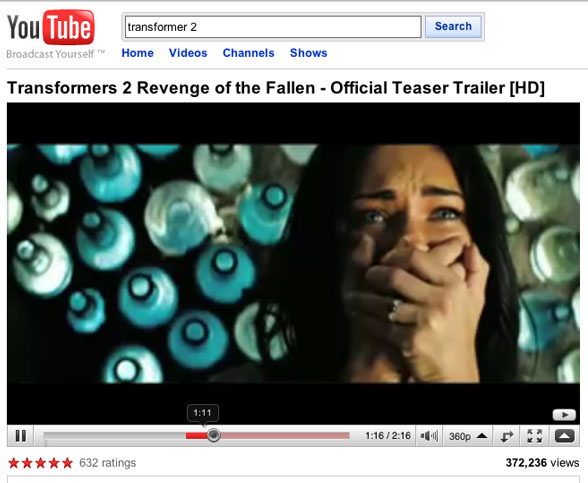
The image was enough to floor me, but then there is this quote, from Director of Photography Ben Seresin -
The shot wasn’t specifically storyboarded, although there was extensive pre-visualization for the rest of the scene. The bottled wall was planned, as it is typical in the Middle East. I tried to create a feeling in the room that would give a sense of safety, and that contrasted with the expanse, scale and danger of outside.
The key phrase for me being The bottled wall was planned, as it is typical in the Middle East. 'Bottled Walls' are typical in the Middle East?? I'd never heard that before, so this is intriguing.
So, are these Middle Eastern bottle walls not recorded by anyone? Or recorded but not put up on the web? Or are they on the web but not in English, therefore harder to find?
Whatever the reason, I've never come across an image of a Middle Eastern bottle wall on the web, other than this. I'll keep searching. In the meantime, if anyone out there hears of or sees evidence of the typical Middle Eastern wall, send it to me.
February 02, 2010
Bottle Wall Videos
I realized the other day that I hadn't checked for new bottle wall/house videos in over a year. So I checked and found there are quite a few newer ones on YouTube and elsewhere. Still nothing good about building bottle walls or houses, but some unique insights into existing structures. And one or 2 wild experiments like this one of a bottle wall turned into an animated LED display. Most interesting toward the end is to see the Times Square type text display and then realize that these are bottles!!
Bacardi Bottle Wall, LED lit bottle wall, by Alex Beim of tangible interaction. There is no sound.
Bottle wall (no sound) from Alex Beim on Vimeo.
Make sure to check out the very detailed flickrset on the Bacardi Bottle Wall, with many construction details.
6 more recent bottle house videos below the fold...
A film about Grandma Prisbrey and her Bottle Village. It seems to be an amateur or student film, possibly from the mid 70's. It contains the only footage I've seen of her actually building one of the bottle walls.
This one is new to me, and I don't have much information, as I have no idea what they are saying. I do know this is located in Uzice, Serbia.
A video about the Bottle Temple in Thailand.
Two recent videos from 'Viscape', in a kind of amateur travelogue style, showing the bottle house on Prince Edward's Island, Canada.
This is showing the interior -
This shows the garden and glimpses the exterior -
Finally, not a bottle house or wall, but still taking bottles and making stained glass out of them. In this case a lamp from crushed and fused Heileken bottles.
November 03, 2009
Earthship Houses on Fry in America
This is a segment from the documentary series Stephen Fry In America. In this segment Stephen visits the earthship houses of New Mexico, and talks with the architect Michael Reynolds.
There is no specific reference to the stained glass quality of the bottle walls, as they only talk about the sustainablity issues of earthship houses. Yet there are many shots of bottle walls throughout the piece, some of them utilizing the transmitted light and some not.
The Earthship segment is from 2:15 to 6:45.
March 28, 2009
In a Dream Trailer
Isaiah Zagar is a mosaic muralist who also does bottle walls, and is best known for the Magic Gardens in Philadelphia, PA. This is a trailer for the upcoming documentary about Zagar by his son, Jeremiah. It looks to be a highly personal view and I suspect it might be pretty intense. It's already won several festival awards and advanced word is strong.
IN A DREAM: Theatrical Trailer from Herzliya Films on Vimeo.
Also check out the In a Dream website for further info, including schedule dates. NYC release date is April 10th.
March 12, 2009
Stained Glass at the City Museum
The most unique cultural institution in St. Louis is without doubt the City Museum. It is not so much a museum as it is a playground that happens to be a work of art, as well as a place for a collection of lots of stuff. It has, among other things, its own aquarium, its own circus troupe, a second hand clothing store, a glass blowing studio, a "museum of mystery, mirth and mayhem', tons of caves to climb through and a jungle gym set like no other, called 'MonstroCity'.
Photo of MonstroCity from flickrite 'mesjak'
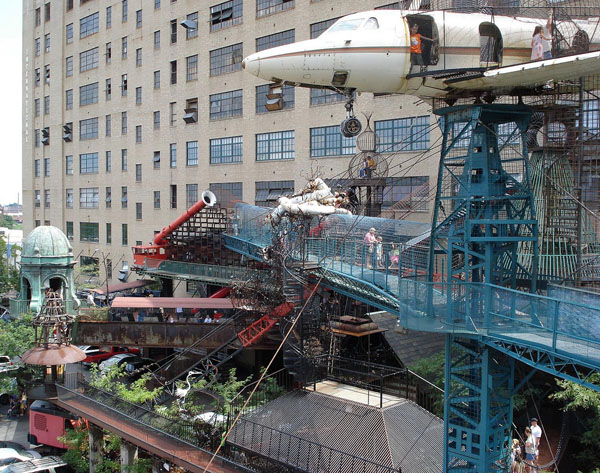
Kids and artists love it. Parents do too, even with the slight air of danger. A friend of mine called it a 'parental anxiety machine'. I've never seen the same expression of wild unfettered creativity expressed in any public venue before. It is to St. Louis' credit that they simply let this thing happen.
There is also stained glass, in one form or another, peppered throughout. I've posted a City Museum stained glass flickrset on my flickr account - City Museum, St. Louis - Stained Glass Plus. I'll continue to add more as I take more pictures in the future.
In the meantime, I have a brief overview of what's at the City Museum, mostly in terms of the stained glass, below the fold...
[update Sept. 26, 2011 - Sad to hear of the death of Bob Cassilly, the founder and creative driving force behind the City Museum. Deepest condolences to his family, friends and co-workers. Let's hope the City Museum can continue to thrive for many years as a testiment to his vision.]
Mosaics
The first thing you see are the mosaics.
This video is a much better intro to the mosaics than anything I can come up with, and it also gives a good general intro to the atmosphere of the City Museum.
From "Living St. Louis", a local PBS TV series -
about the creator of the mosaics - "Sharon Von Senden - Mosaics" (7:19)
Architecture Hall
These images are located in the Architectural Artifacts section of the City Museum. This is one of my favorite sections of the museum though not so popular, probably because this is the one area that is more museum and less playground.
They have some 10-12 stained glass windows within this area, though most of the Hall is filled with decorative stonework.
Landscape Window
This landscape window is probably my favorite of the stained glass pieces.
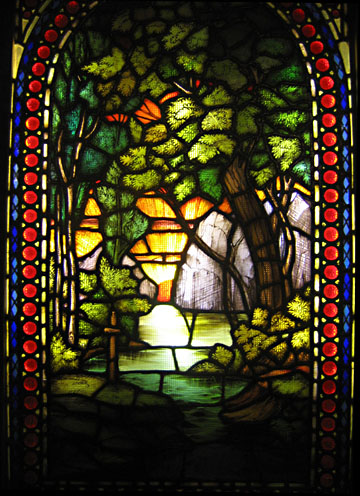
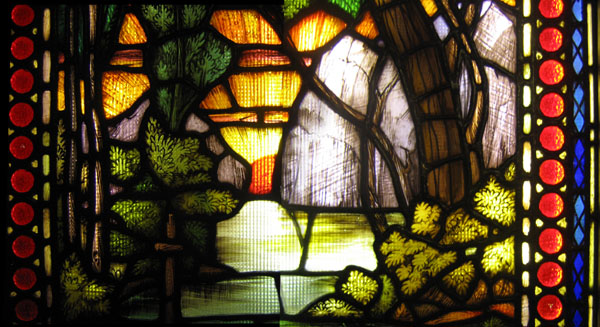
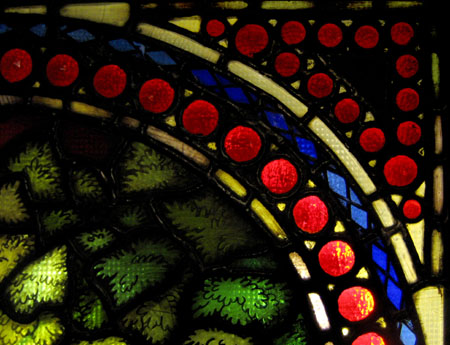
I suspect that this might be a mausoleum window, especially after I came across this image of this stained glass in Flushing Cemetary.
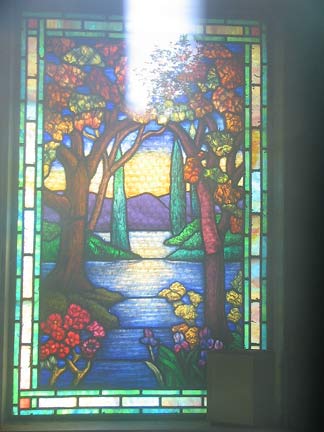
These next two images are from the Flickr set by Dimberly
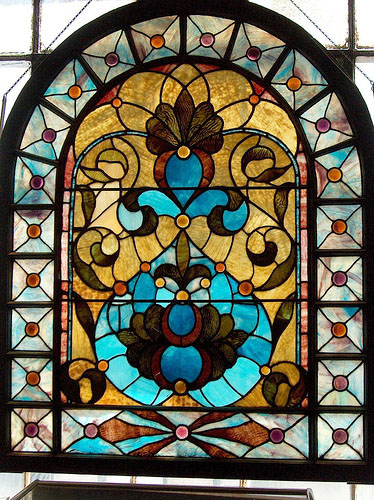
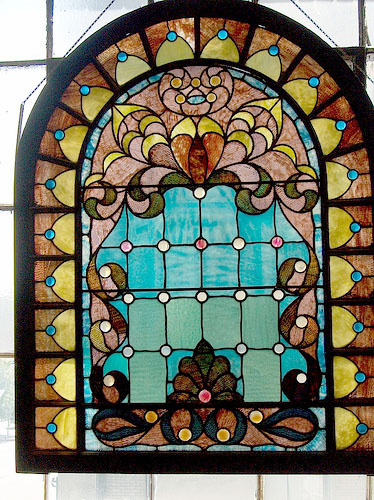
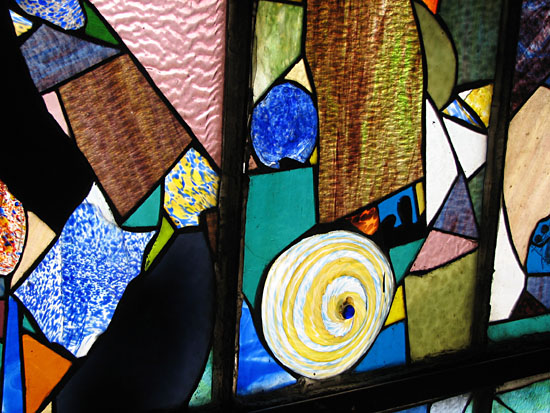
Aquarium Patchwork Window
There are about 4 or 5 stained glass windows in the aquarium. This patchwork window is the largest. I believe some of the glass in this was made at the on site glass blowing studio. Note that it is in a real aquarium. This window is right by the 'sting ray viewing platform'. There is an alligator only about 30 feet away.
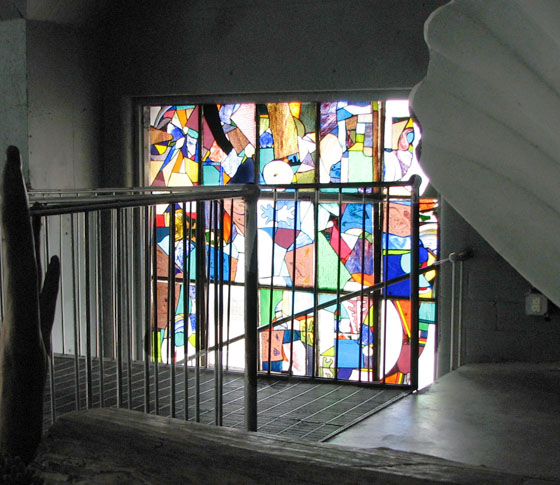
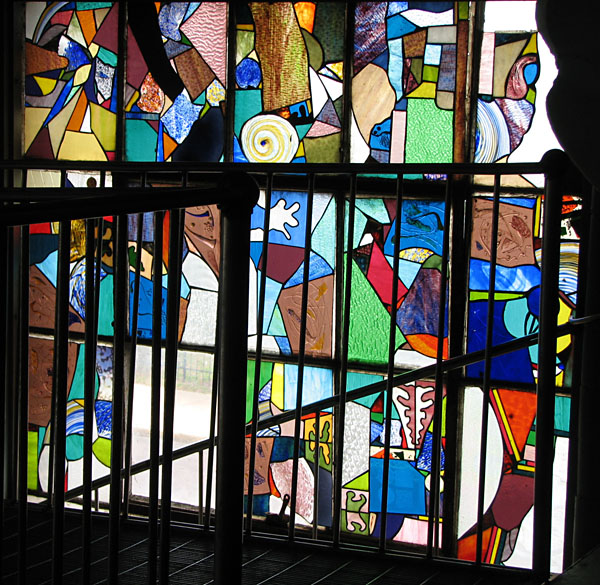
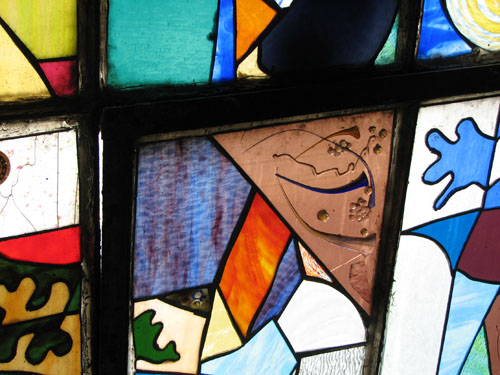
Bowl Wall
This is a wall sectioning an area where they have birthday parties and the like. It is in the same room as a vast playground, kind of an indoor skate park without skaters. I think it was considered too dangerous to let actual skaters loose on this. Kids go wild in here. Seriously.
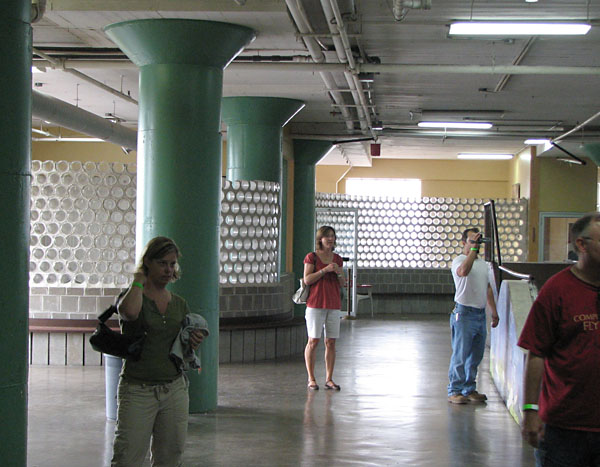
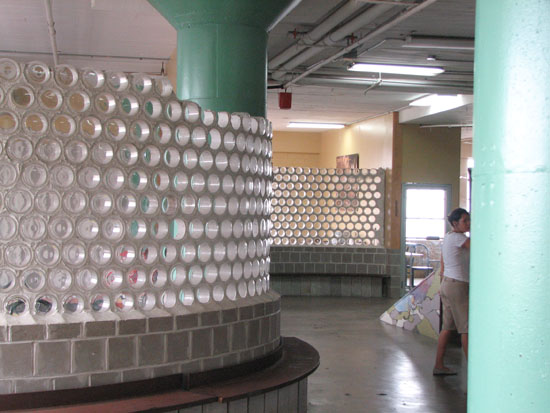
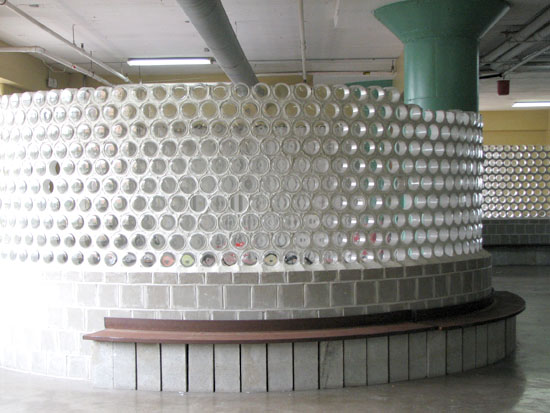
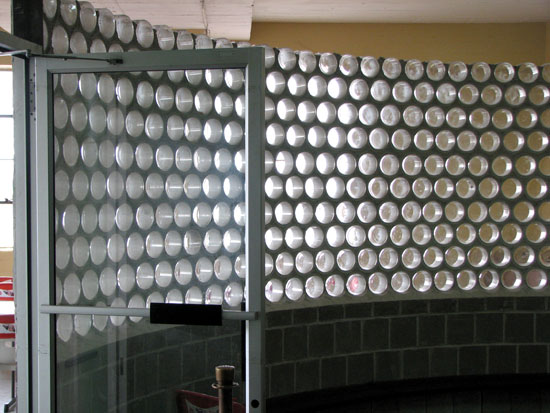
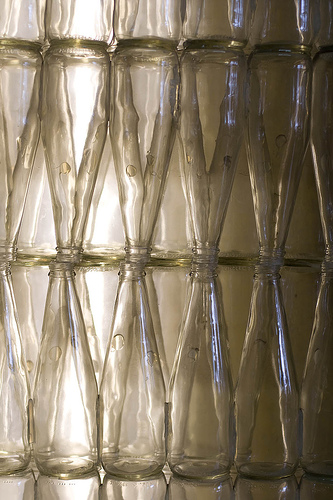
Clear Bottle Wall
This is one of two clear bottle walls in the museum, near one of the exits leading to MonstroCity. Thee bottle are glued together with clear silcone caulk.
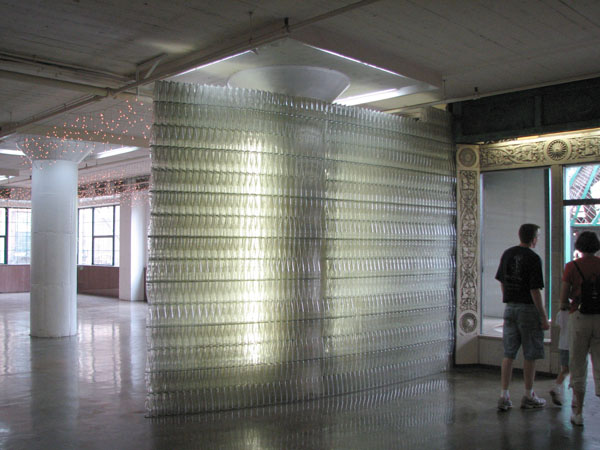
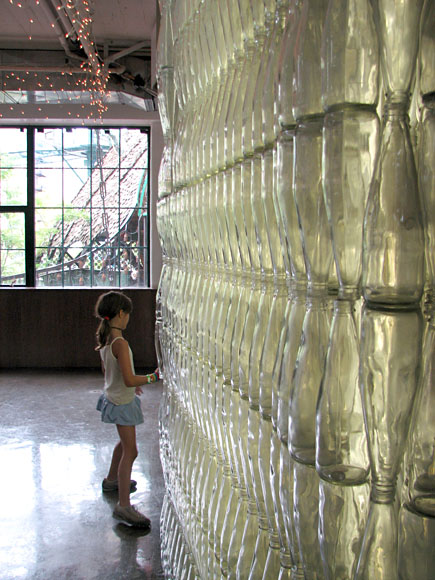
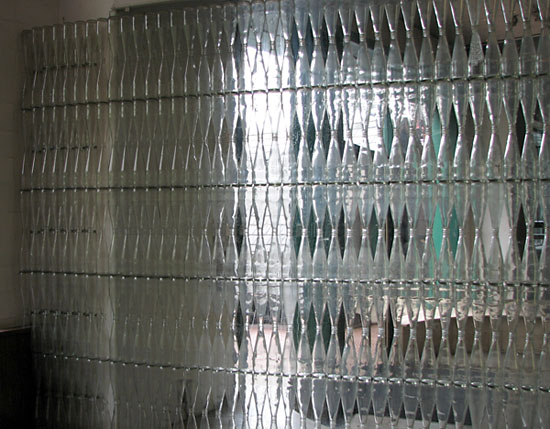
from rsun78 flickr page
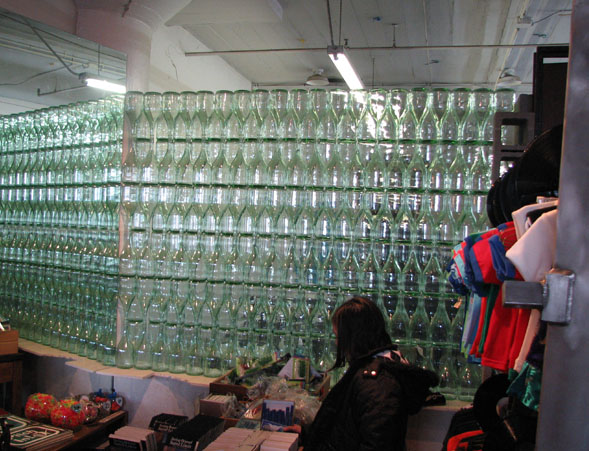
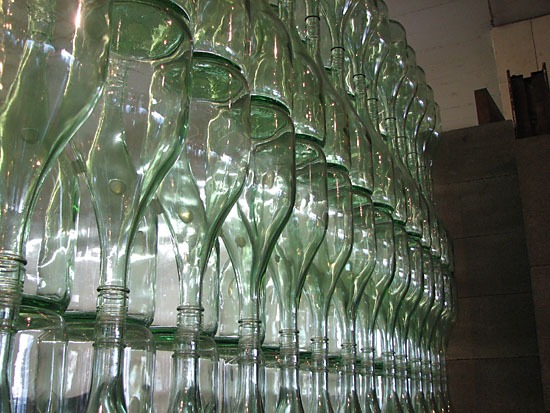
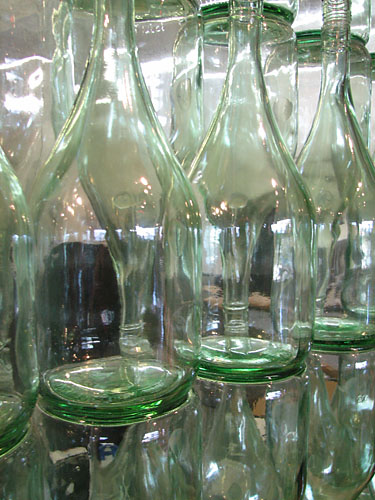
Big Clear Bottle Wall
This bottle wall is similar the the 'small bottle' bottle wall, only with large bottles. I've never seen large, clear, thin-neck bottles like this and I'm not sure what they would have been used for. It's located on the fourth floor, where there is a small knick knack shop and a large warehouse sized room with a shop selling vintage clothing.
Oh, did I mention the room filled with old opera posters. That's a favorite of mine too, but it will have to wait for another time...
For more images, I suggest a Flickr search for City Museum, St. Louis. There are thousands and thousands of City Museum images.
There are also some interesting interactive panoramic images of the City Museum, through a thing called Gigapan. Not unlike Zoomify, but with extreme wide angle images.
February 20, 2009
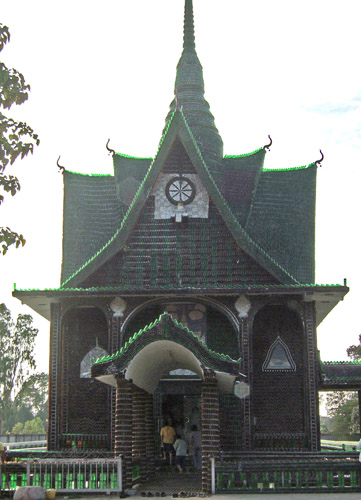
Buddhist Bottle Temple on Flickr
New images of the Thai Buddhist Bottle Temple
with a flickr search for "bottle temple".
from flickrite plumandjello -
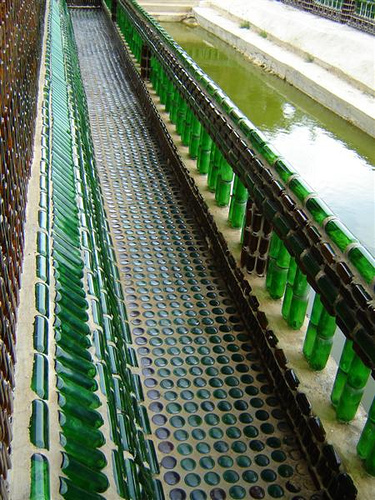
and this wonderful Beer Bottle Buddhist Temple flickrset of 32 photos by aimforawesome
February 15, 2009
Bottle Houses on Box Vox
Box Vox, a blog whose motto is packaging as content, has done some interesting posts on bottle walls/houses. Most of the post called 8 Glass Bottle Houses covers familiar territory, but with additional and updated links. Worth a good look through.
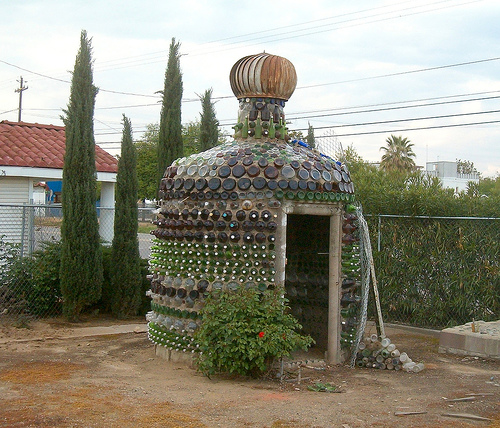
Then more recently, Box Vox highlighted this "Fractal Bottle House", which is a Bottle House photographed by flickrite Matt (mistergoleta).
No interior shot, unfortunately, but nice to see anyway.
October 28, 2008
Temple of Million Bottles
Buddhist temple builds refuge from refuse - article via Reuters.
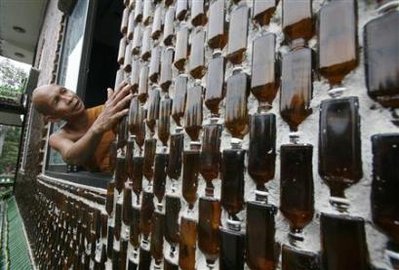
(photo by Reuters)
quote from the Reuters article -
The Wat Pa Maha Chedi Kaew temple, about 600 km (370 miles) northeast of Bangkok, is better known as "Wat Lan Kuad" or "Temple of Million Bottles" because of the glittering from countless glass containers on the walls.
Wow. I'd never heard of this before today. Make sure to check out the slideshow. The sheer volume of bottles is astonishing. I only wish I could find more backstory.
The Reuters article came out a week ago and the images seem to be racing around the environmental blogs, some with added images, such as these articles on treehugger.com and greenupgrader.com. Note that this is making a splash on the environmental blogs and not, at least initially, on any art, design or architectural blogs.
March 31, 2008
The Garbage Warrior
I'm stunned. A mention of bottle walls on, of all things, a comedy news show - The Colbert Report. It's an interview with Michael Reynolds, promoting the movie The Garbage Warrior, which is about Reynolds' efforts in creating the Earthship Houses in the southwest USA. Notice how in the interview Reynolds even refers specifically to the bottle wall as 'stained glass'.
January 06, 2008
Tio's Tacos
Via Extreme Craft, a flickr set of Tia's Tacos, in Riverside CA, with its folk art environment including a bottle wall chapel. Alas, the only interior shot...
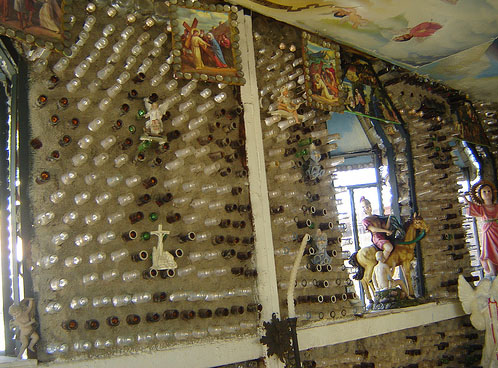
Also, look at some very nice shots of the same place, with better interior shots, on this unusuallife.com 'Riverside California Folk Art' post.
July 10, 2007
Recent Bottle Walls on Flickr
Curious that there seems to be more and more bottle walls and bottle houses popping up on the web, especially on Flickr. All these are from Flickr and all were posted in the past 3-4 months -
anonymous close up
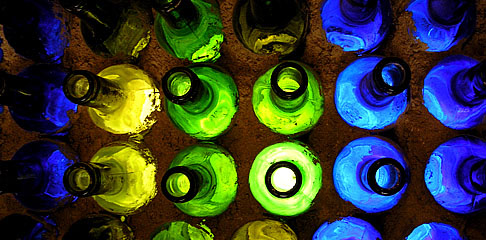
First of all, a few sites I'd heard of but never found images for -
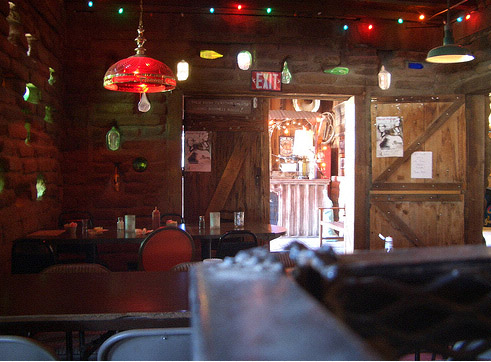
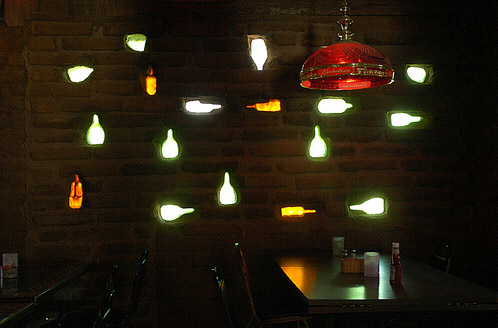
Pioneertown, CA
this is at Pappy and Harriet's Pioneertown Palace (though no mention of the bottle walls on their website)
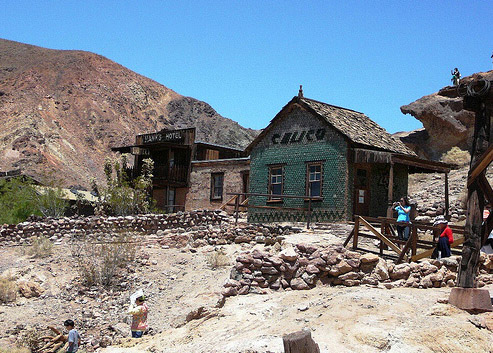
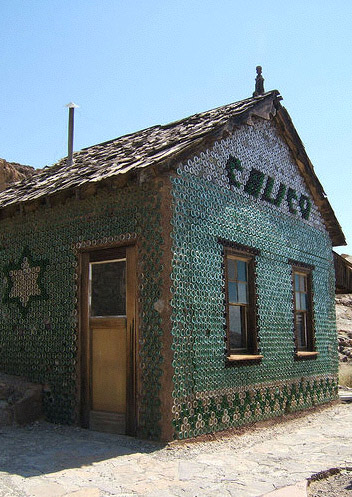
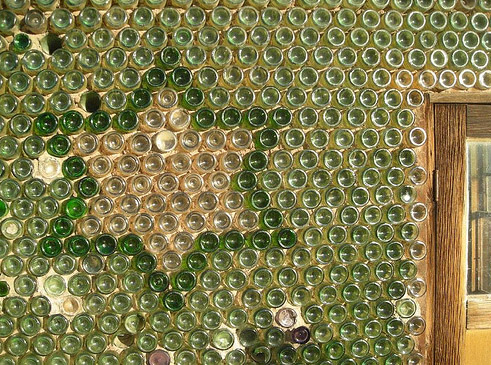
Calico House
The Ghost Town in Calico, California. I'd seen a few images of this house before but not in such a wide range of angles.
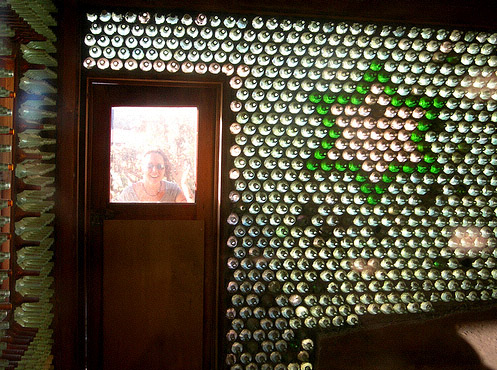
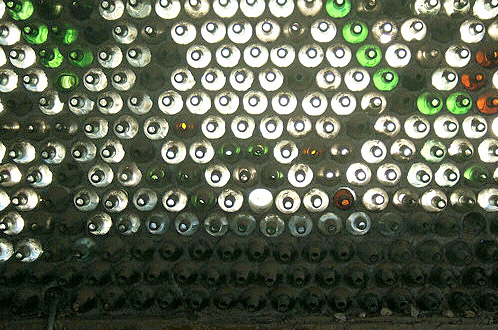
Prince Edward Island
I'd heard of these three bottle houses on Prince Edward Island Canada by Edouard Arsenault before but, again, I simply hadn't stumbled upon quite so many images before... and you get many more images with a Flickr search of Prince Edward Island Bottle. These are just a few recent images...
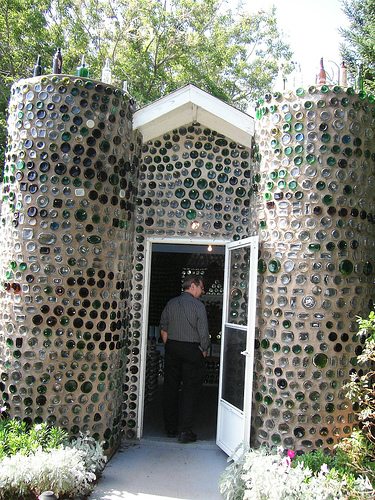
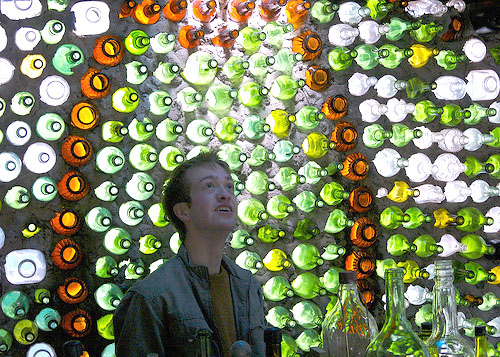
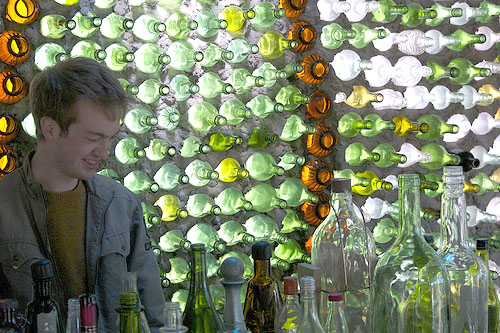
Earthship house
Part of a set from a couple building their won earthsip house in New Mexico.
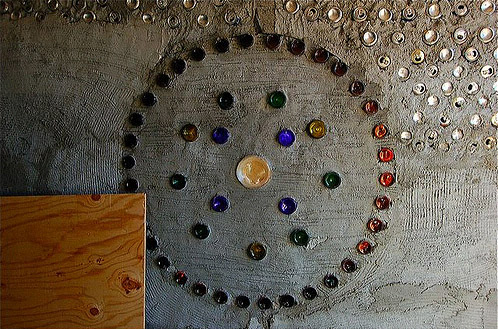
UK Bottle Dome
outside of the roof of the bottle dome in the waste and recycling zone of the Centre for Alternative Technology in Wales -
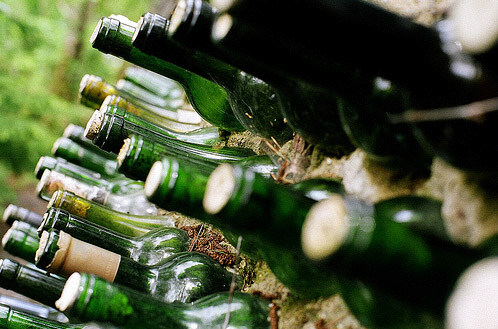
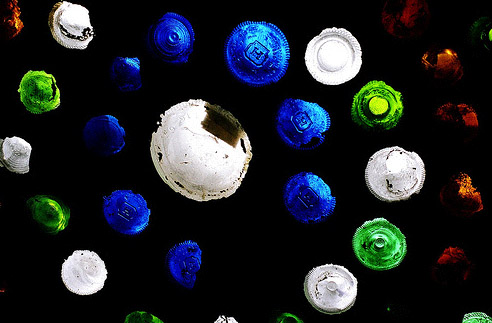
The New Zealand Bottle Wall Thing
Why New Zealand as the new vanguard of bottle wall/house creation? Is it the remoteness?, the eccentricity of the populace?, a 'green' revolution?, or the Hundertwasser influence? - or some combination of all? In any case, there seems to be a great deal of bottle wall activity happening in New Zealand.
Wellington New Zealand Bottle House
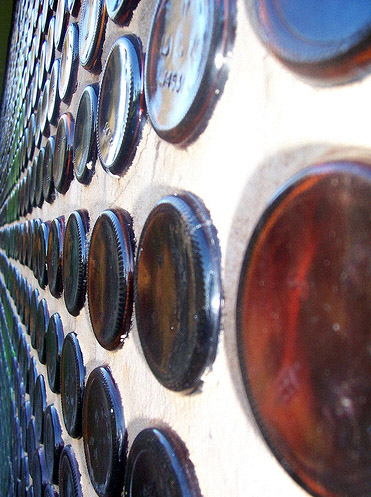
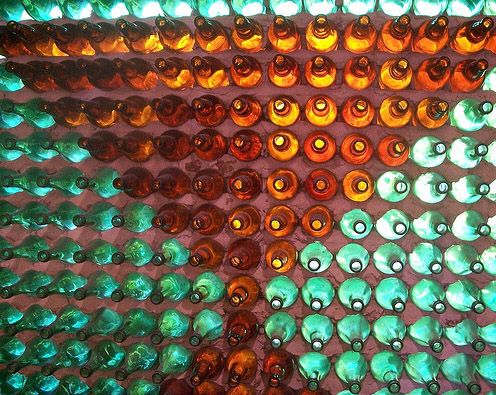
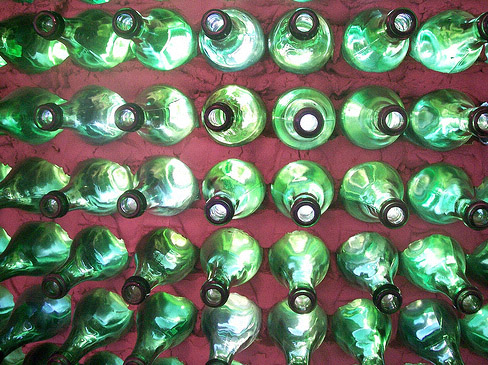
The Hundertwasser influence in New Zealand
A New Zealand art studio with a small bottle wall in the style of Hundertwasser.
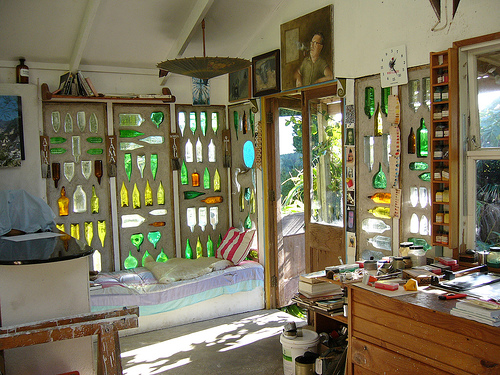
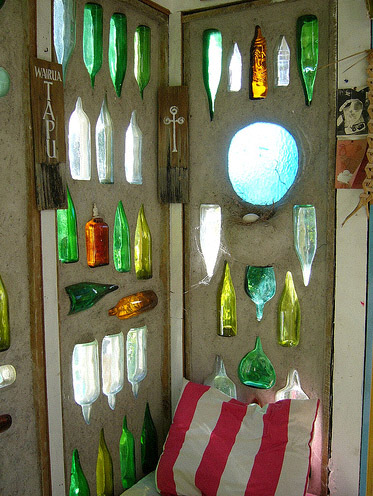
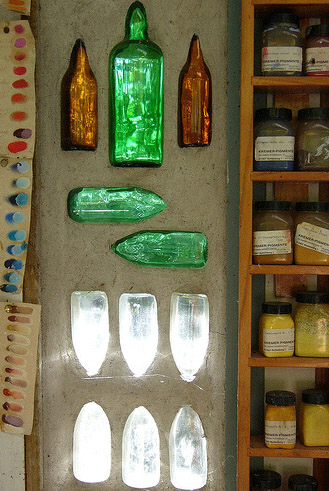
Another New Zealand Hundertwasser style small bottle wall.
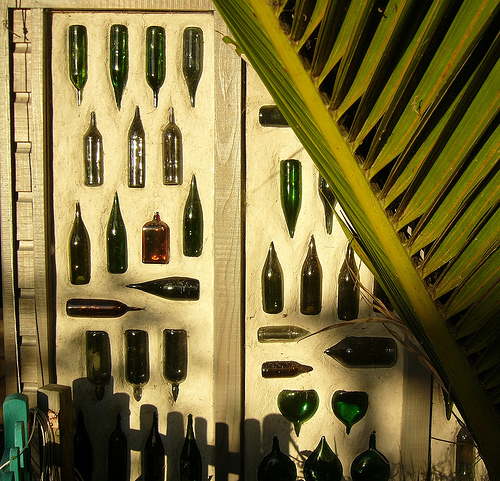
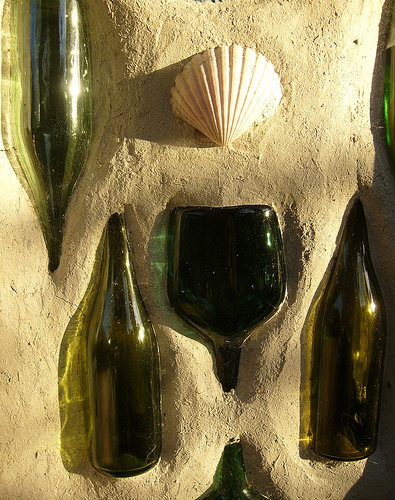
Carlucci Land -
Detail photos of a bottle wall in New Zealand at Carlucci Land, a sculpture park in Wellington.
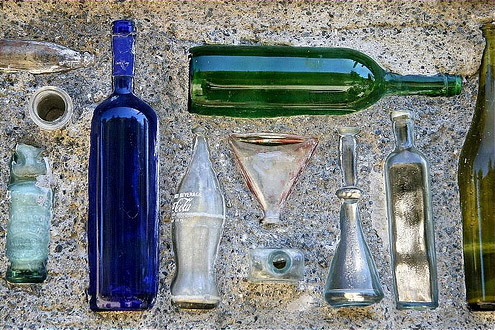
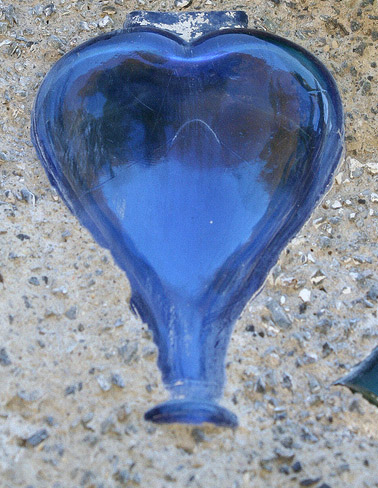
finally -
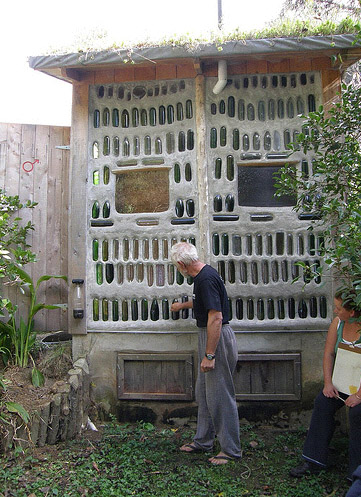
the New Zealand Composting Toilet
doubly inspired by Hundertwasser...
May 26, 2007
Grandma Prisbrey Video
Heard a story on NPR this morning about a web based video service called Folkstreams.net. They describe themselves as a "National Preserve of Documentary Films about American Roots Culture". The site features video streams of full length documentary films, mostly about folk artists and musicians. I went there and first thing came upon a documentary from 1982 called Grandma's Bottle Village: The Art of Tressa Prisbrey.
It's a 28 minute film interviewing Tressa Prisbrey and doing a tour of Bottle Village in it's prime. Well worth seeing for the bottle wall enthusiast.
March 25, 2007
The Bottle Wall, revisited
I received so many positive responses to the Bottle Wall piece that I thought I would do a brief follow up.
Starting with this amazing photo of the artist Charles Stagg in his home in Vidor, Texas.
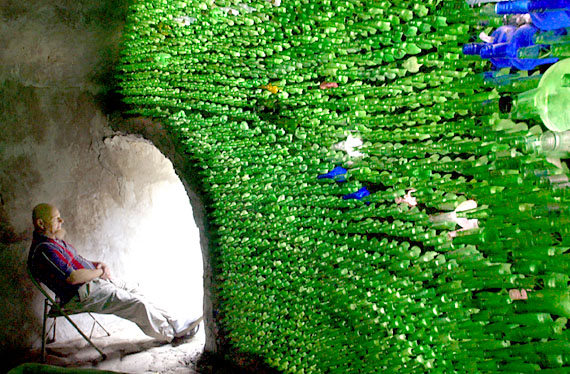
Photo credit to 'Scott Eslinger/The Enterprise July 31, 2005'
Individual Bottle Houses
Charles Stagg's 'A.V. Stagg Art and Wildlife Preserve'
Charlie Stagg is an East Coast educated but Texas born and bred artist who created this house starting in the 1960's. From his home in Texas he has created his artwork and built onto this house for some 40 years.
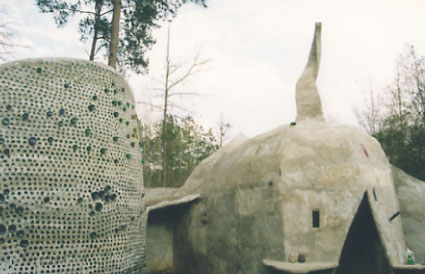
Another take on Charles Stagg can be seen here at narrowlarry's site
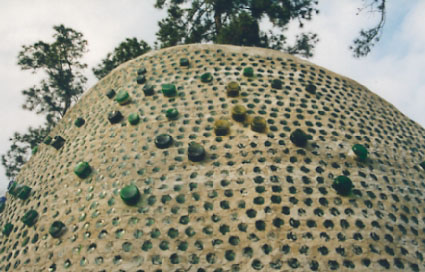
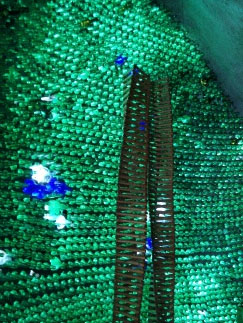
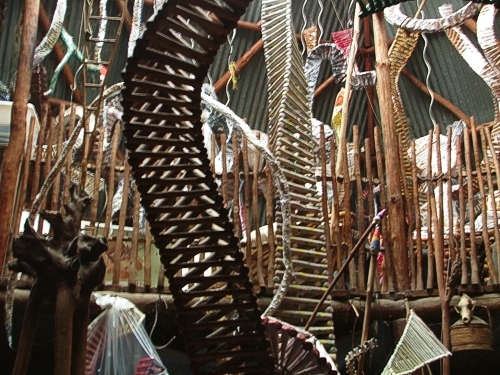
A picture of his studio and his artwork. The studio apparently burned down in 2006, though most of the house remains intact.
Luna Parc
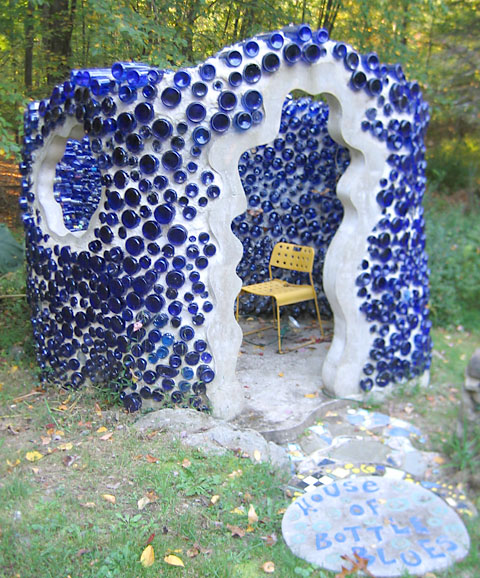
I received this image of a work-in-progress from Ricky of Luna Parc. Great idea to do all blue bottles. Can't wait to see the finished structure.
Anna's Bed & Breakfast
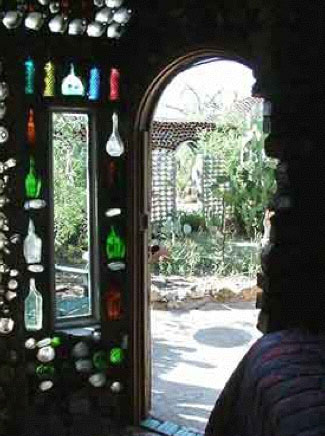
This is Anna's Bed and Breakfast near Tucson, Arizona.
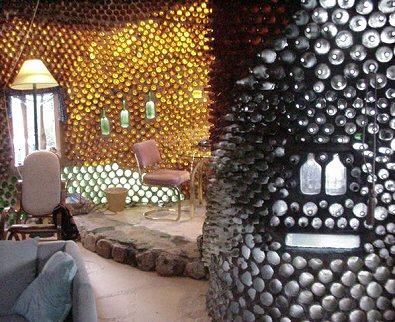
and a part interior, part exterior shot. I like the use of the upright bottles in this one.
Rockome Gardens
Rockome Gardens is the one of the few places that discriminates as regards the brand of bottle used.
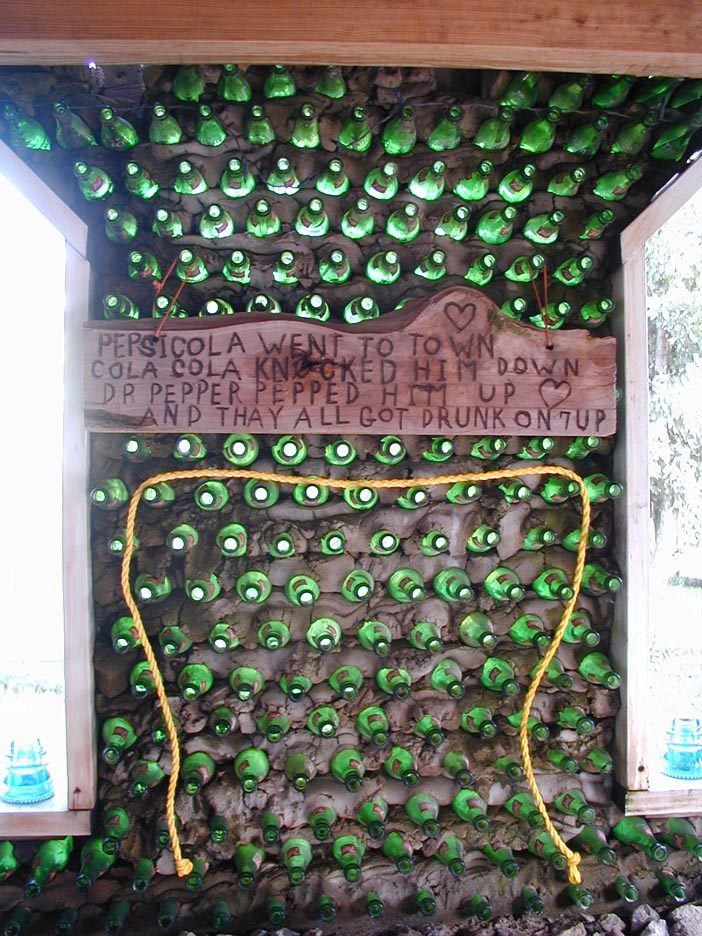
i.e. - these are all Fresca bottles.
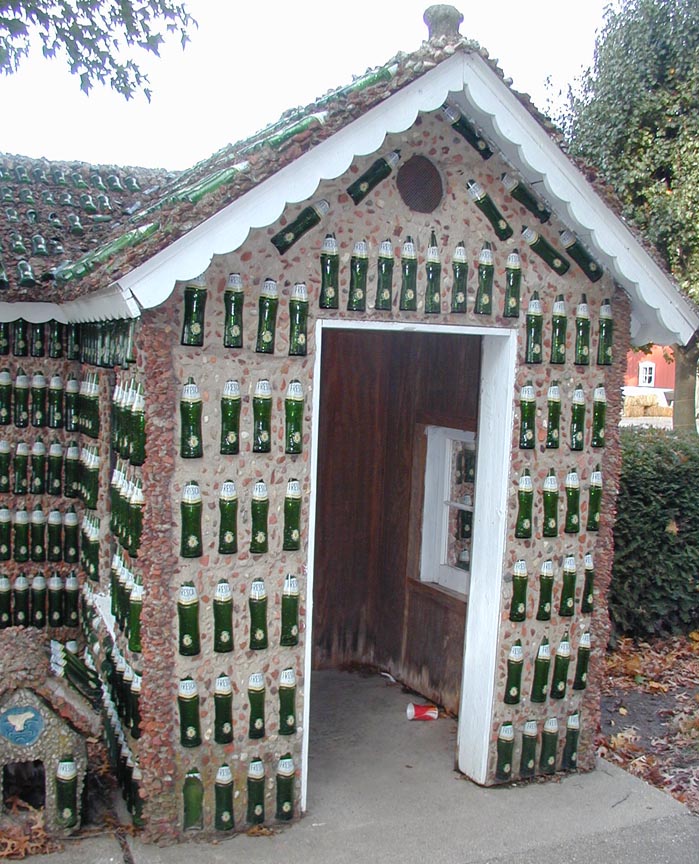
and these are all 7-up bottles.
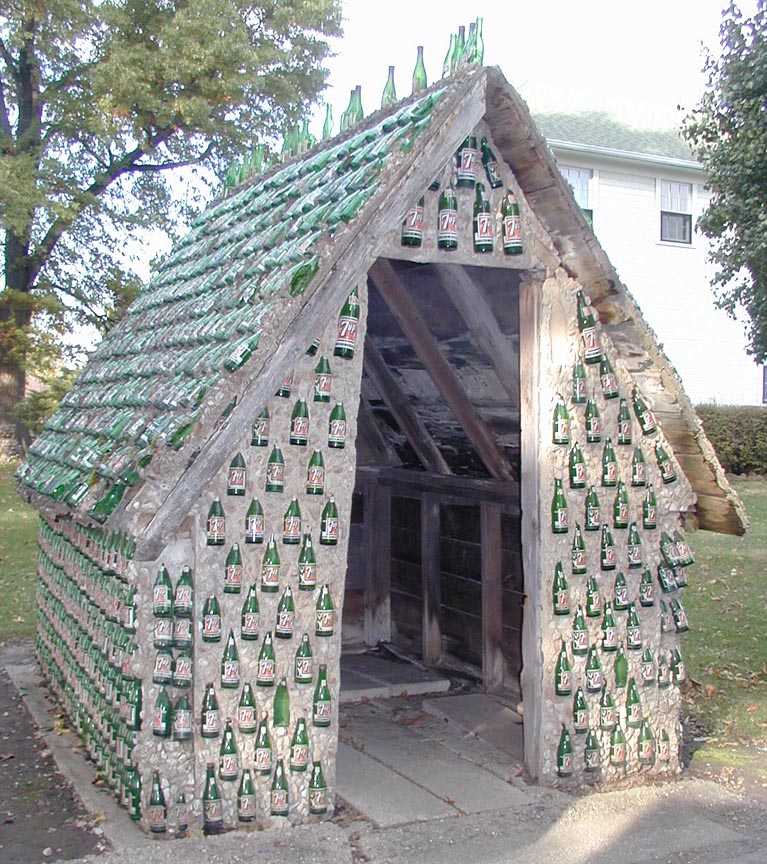
It does make me wonder why the Coca-Cola bottle, with it's distinct shape, has never been used for a bottle wall.
I had intended to put the Rockome bottle houses in the original bottle wall post but thought better of it since, sadly, these structures no longer exist. Acquired by new ownership and not deemed to be a part of their vision for the property (some kind of Amish-themed Park), the new owners demolished the bottle houses in 2006.
Kaleva Bottle House
John Makinen built this bottle house in the 1940's in Kaleva, Michigan with bottles from a local bottling plant. It now houses the Kaleva Historical Museum. I like the incorporated text.
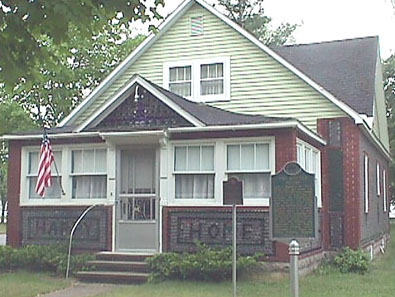
Note the variety of bottles in the closeup -
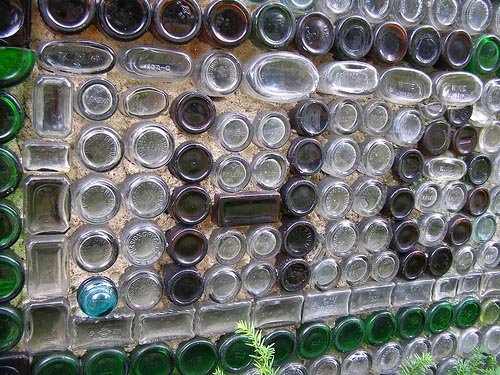
I found the closeup via the amazing and wonderful agilitynut flickr pages. If you like Roadside Attractions (including Bottle Houses), this is the place to go.
The Curious Case of the World Bottle
Like many entries on Wikipedia, the Wikipedia entry on Bottle Wall is as interesting in its omissions as it is in its inclusions, but it's certainly worth a look... and it does mention the Heineken World Bottle, also known as the 'WOBO' or the 'brick bottle'. A quick backstory via Wikipedia -
As the story goes, Alfred Heineken had an epiphany while on a world tour of Heineken factories. When Heineken was on the Caribbean island of Curacao in 1960 he saw many bottles littering the beach due to the fact that the island had no economic means of returning the bottles to the bottling plants from which they had come. He was also concerned with the lack of affordable building materials and the inadequate living conditions plaguing Curacao's lower-class. Envisioning a solution for these problems, he found an architect to design what he called "a brick that holds beer."
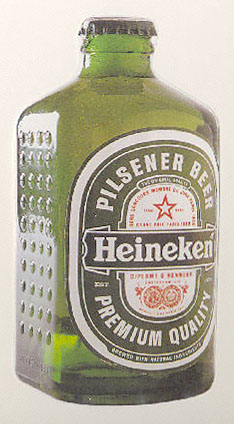
Notice how the bottom of the bottle is recessed so that the neck of the bottle would fit snugly into the bottom.
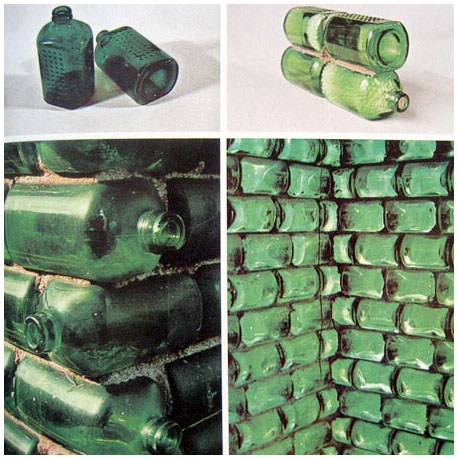
There were apparently 2 sizes, roughly equating to the idea of the brick and the half brick.
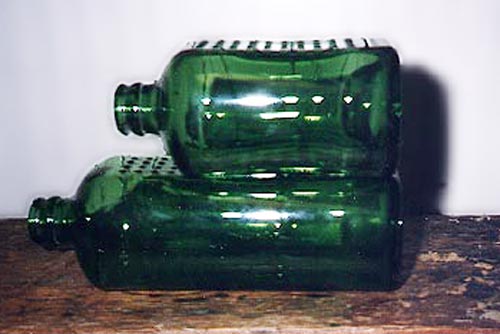
The bottle was designed by Architect John Habraken. They did manufacture the bottle but never released it commercially. Nothing much came of it and there are apparently only one or two existing structures, on the Heineken estate, known to have been made from the bottles. Rumor has it that there are some 60,000 of these bottles in storage somewhere in the Netherlands.
[update feb 2008 - found this Inhabit.com article on the WOBO that includes this image of what is presumably a building with a wall made of WOBO bottles. No further attribution is given.]
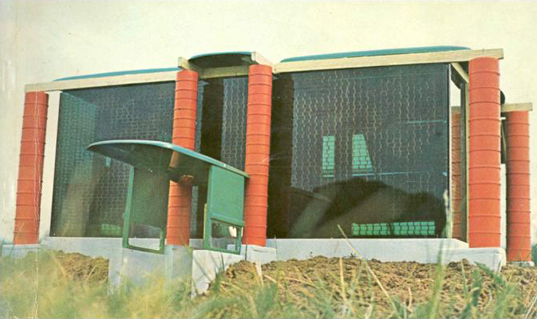
Looking at it I'm not surprised the idea failed. It seems almost an impossible balance - the basic utility of holding beer, balanced with the idea of 'brand identity' as well as the idea of 'sound building material'. Still, it's interesting to see that it went as far as it did and it definitely strikes me as an idea ahead of its time.
How to build a Bottle Wall
I've been asked - are there any resources to let me know how to build a bottle wall? I've searched on the web and so far, no luck. Though I did find this case of a team of people trying to build a bottle wall. Though on close reading it comes off more as how not to build a bottle wall.
March 03, 2007
The Bottle Wall
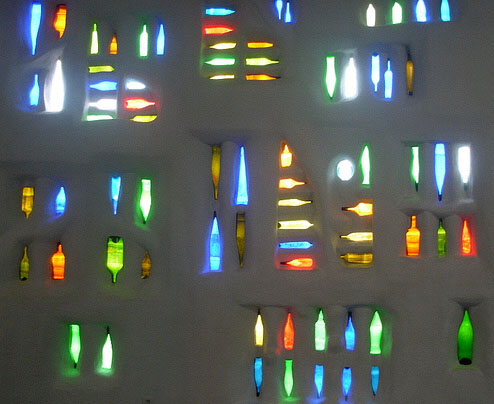
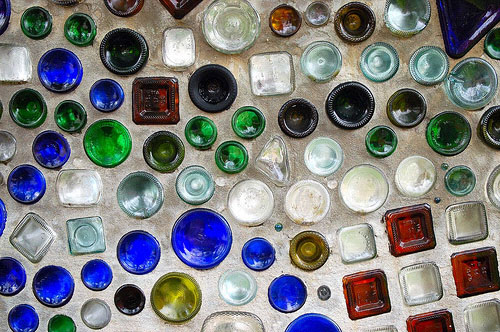
Introducing the Bottle Wall, a peculiar form of stained glass. You won't see any mention of bottle walls or bottle houses in the stately and academic tomes of stained glass history. But stained glass it is, and it deserves recognition.
anonymous bottle wall - posted on Flickr
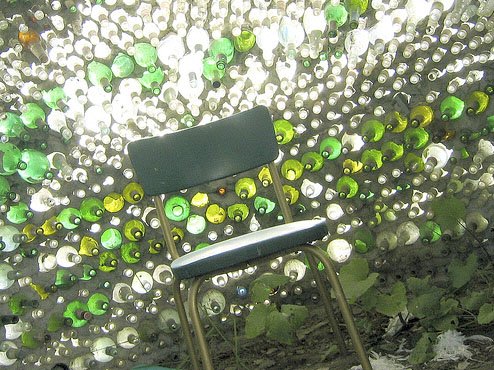
be prepared for lots of pictures...
I became interested in the bottle wall phenomenon most recently through a TV show. Rare Visions & Roadside Revelations is a program exploring outsider art and roadside attractions. It's produced out of Kansas City and so far over 60 shows have been produced in about 10 years. The tone of the show can be fairly described as goofy, but the art that is shown is often amazing and always interesting, and they have visited many sites with bottle walls and bottle houses. So I started researching.
Early History
I don't claim to be an historian, so this will be brief. You will find much more information in the bottle house section of Debra Jane's website on Roadside Attractions.
Bottle houses began as a practical necessity. In remote mining towns where building materials were scarce, someone got the idea of using bottles as a material for building the walls of a house. Such was the case with one of the most famous early Bottle Houses, the Kelly Bottle House in the gold mining town of Rhyolite, Nevada. Because it was located in the desert there were almost no trees, hence no wood. But being a mining town there were 50 bars in close proximity, hence lots of empty bottles.
The Tom Kelly House - Rhyolite, Nevada - circa 1906
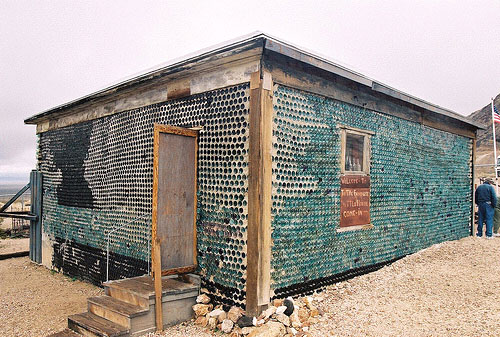
The look of these early bottle houses tended to be more mundane, owing to their utilitarian origins.
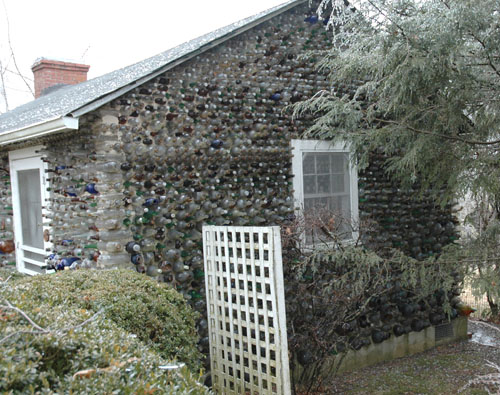
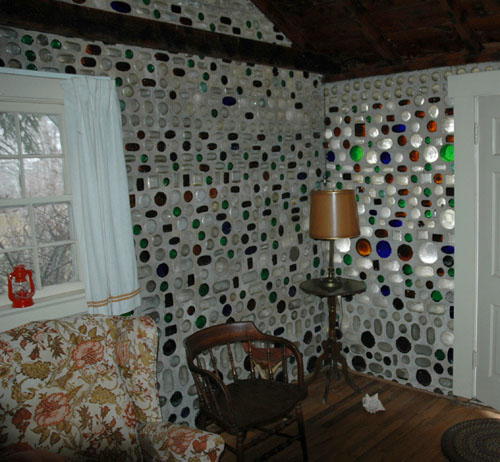
By the middle of the 20th century there was a little more 'art' put into the structures and the motivations were more eccentric and personal, such as in this house built as a playhouse.
The Doc Hope House - Hillsville, Virginia, 1941
Grandma Prisbrey's Bottle Village
Grandma Prisbrey's Bottle Village in Simi Valley, California was created from 1956 to 1980 and features a series of 13 sheds and other small structures on a small lot of land in Simi Valley, California. Though she originally made these structures to house her collection of pencils (17,000 of them!), Grandma Prisbrey really went wild with Bottle Village, well beyond utility.
For many more pictures check these out -
Flickr set on Bottle Village by Babsomatic
Flickr set on Bottle Village by gldyas
Exterior
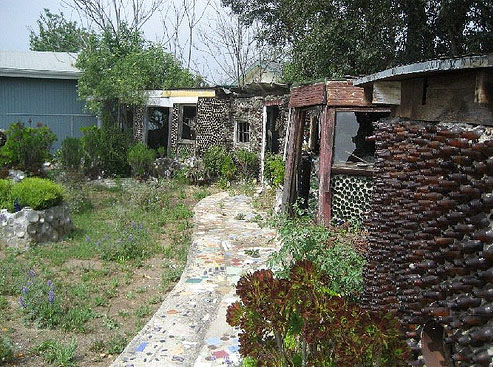
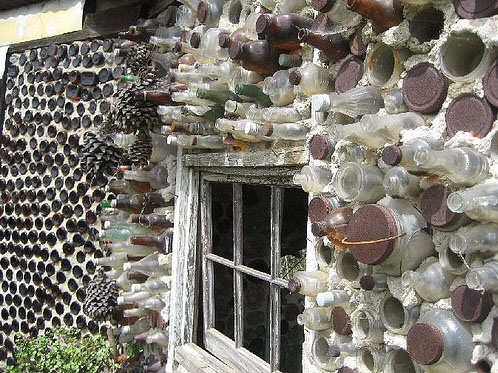
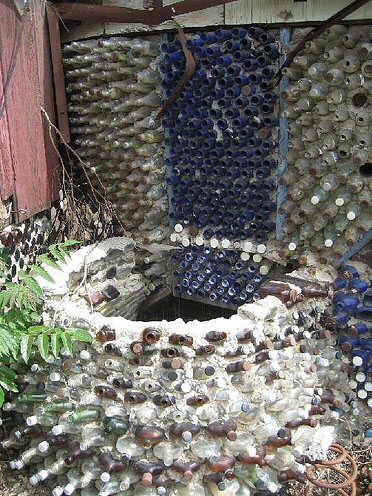
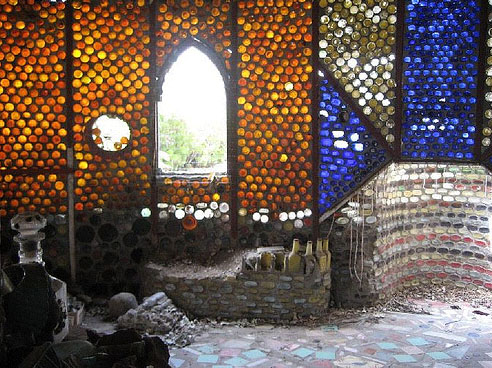
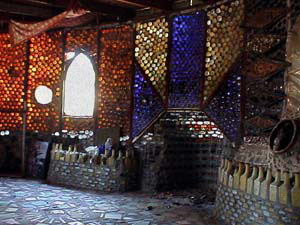
interior of the round house
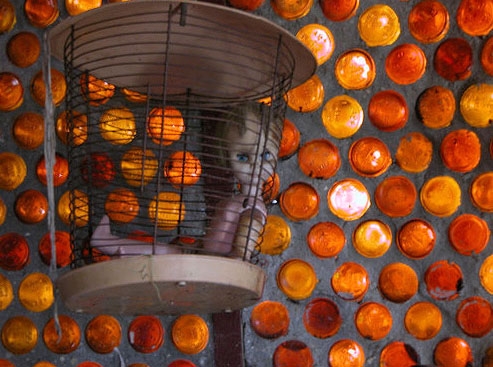
She also had a collection of dolls. Note the beverage tab decoration of the dress.
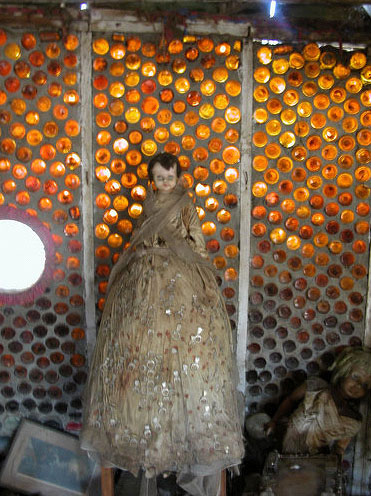
Sadly, much of Bottle Village was destroyed in an earthquake in 1994 and its future remains uncertain.
Tinkertown
Grandma Prisbrey directly inspired other people to create their own bottle houses. Ross Ward was one who saw Bottle Village in the 60's and then went on to create Tinkertown near Albuquerque, New Mexico. The buildings house a museum of his handcarved figures and animated scenes.
Flickr set of Tinkertown by kasiahalka
Exterior of Tinkertown

In amidst the walls of Tinkertown -
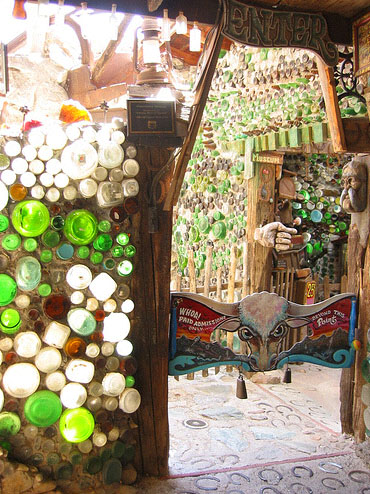
Closeup of a Tinkertown wall highlighting Ross Ward's motto...
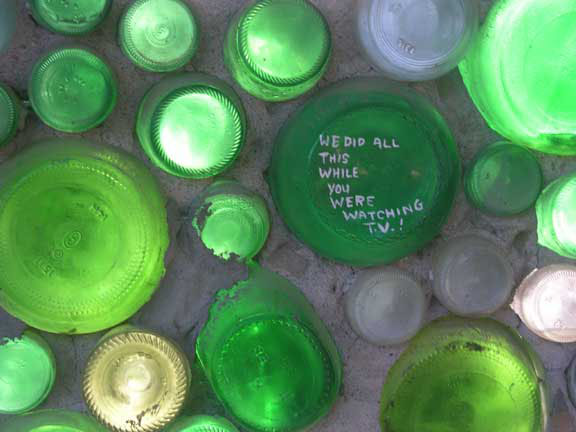
Variety of Styles
A sampling of mostly American and mostly anonymous bottle walls.
Locations cited only when known,
all gathered from a search for 'bottle wall' at Flickr
Thunder Mountain - Imlay, NV
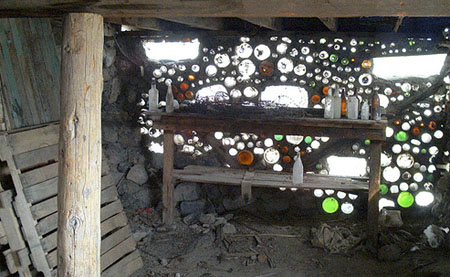
UCM Museum - Lousiana
typical undulating form
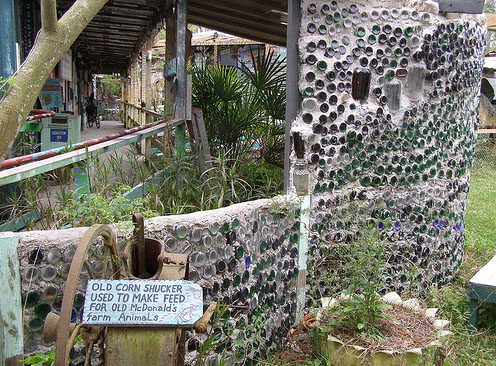
This only said "at a food coop".
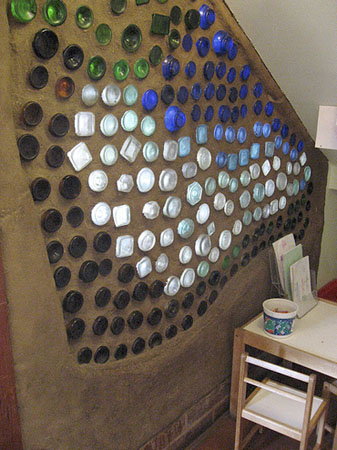
Some have taken to the bottle wall more as an ecological statement on recycling, like this Earthship house near Taos, New Mexico

Another Earthship house.
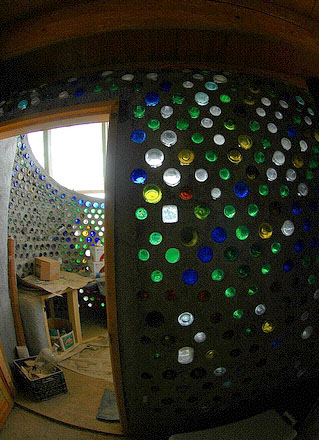
As a small feature in a house, anonymous, in the southwest I would guess.
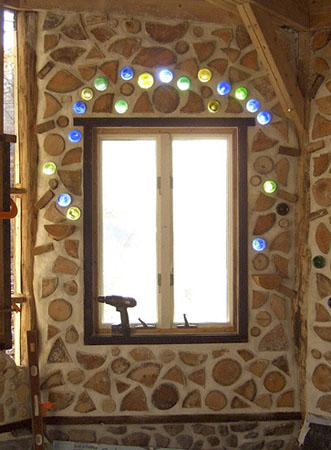
Most bottle walls, especially the garden walls, tend to be rough and messy looking with a kind of improvised mad patchwork quality to them, with no sense of pre-design.
Anonymous American Bottle Wall
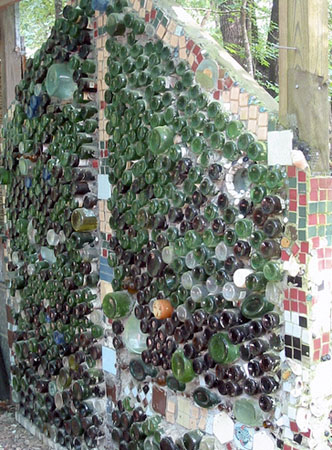
This is another wild one, a wall by an arts center in Deep Ellum in the Dallas area of Texas. I couldn't find the backstory.
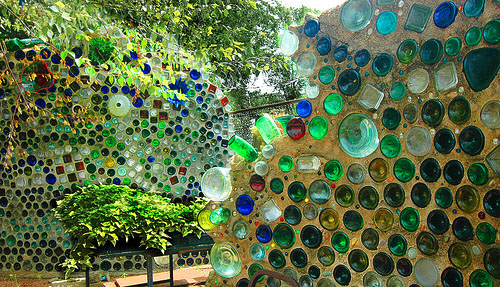
and a close up shot
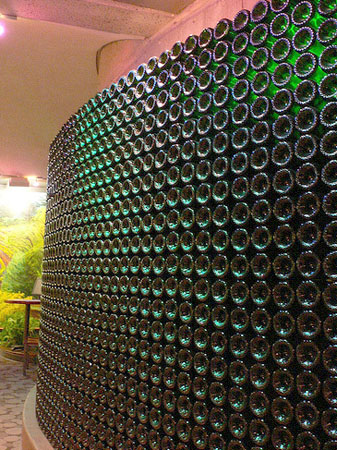
Yet some walls are quite neat and precise. These are often seen in the more commercial or officially public settings, like this from a Napa Valley Winery. The 'neat' walls also tend to forego the use of cement as a matrix for holding the bottles together.
Lightning Ridge
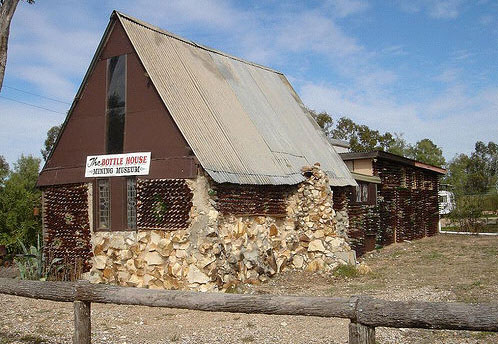
Bottle walls and bottle houses seem to be mostly, but not entirely, an American phenomenon. One striking case outside the USA is in Lightning Ridge, in the outback of Australia. It's an opal mining town that has two bottle house attractions to its credit.
One is the old Bottle House in Lightning Ridge. The standard 'postcard' view -
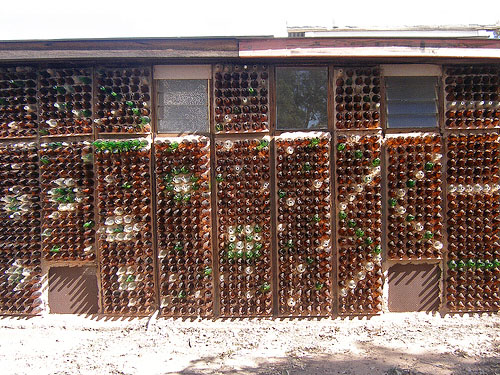
And a closer exterior shot, showing the bottles, which appear to make a specific pattern. The interior seems to be closed, which is pretty common in older bottle houses. Note that there does seem to be some kind of rough pattern going one here.
The other site in Lightning Ridge was started in the 70's when John and Joan Andrews created three sandstone cottages incorporating bottle walls. It's now a tourist attraction called Black Queen. The name 'Black Queen' refers to the name of the type of black opal mined in Lightning Ridge.
The most striking feature of the Black Queen Bottle Walls (and the sites say that there are some 34 of them) are the intricately designed patterns.
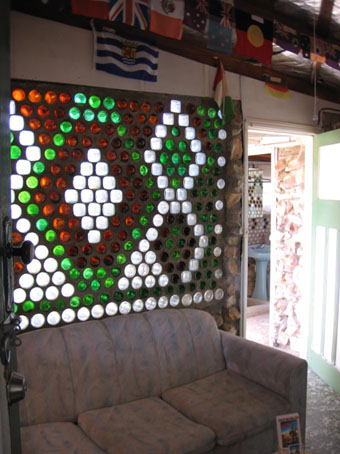
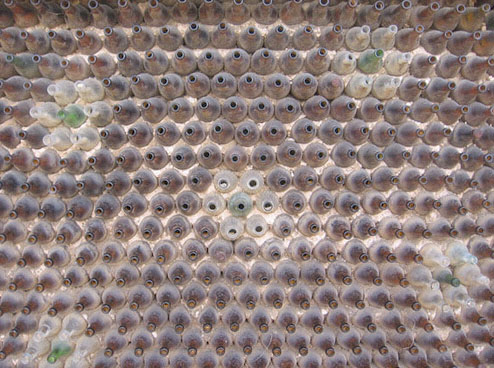
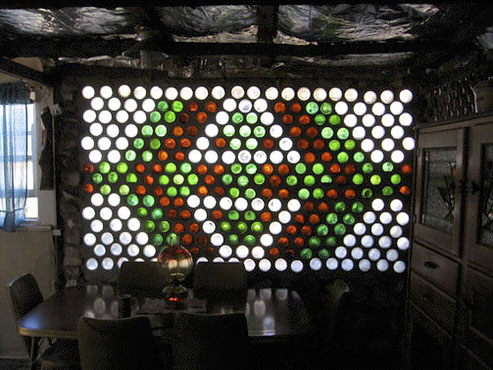
Contemporary Bottle Walls
Zagar's Magic Gardens
Isaiah Zagar in Philadelphia is a muralist who also incorporates bottles into walls. His major creation is the Magic Gardens.
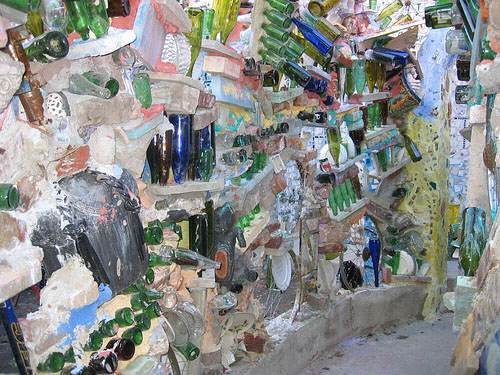
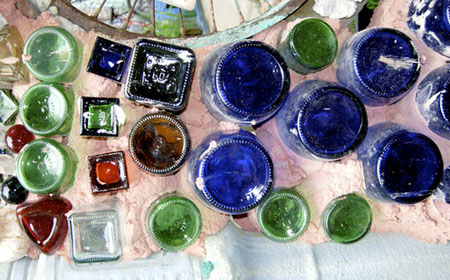
Flickr set of Zagar's Magic gardens by 'Scuzzi'
The Bottle Chapel
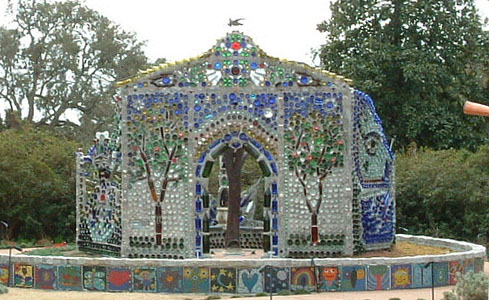
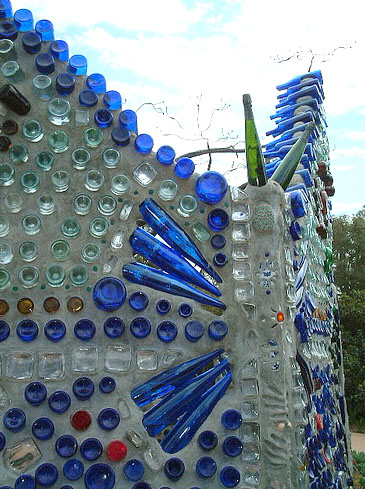
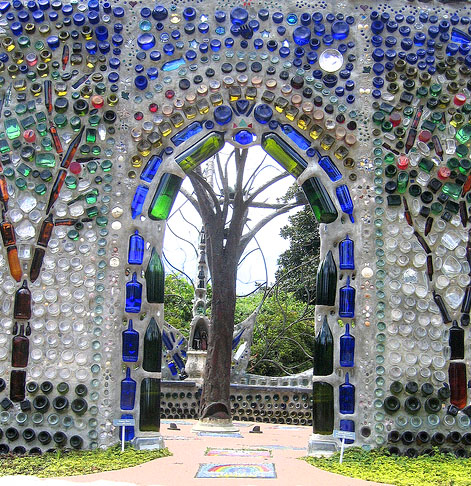
One of the more recent and notable bottle walls is The Bottle Chapel at Airlie Gardens near Wilmington, North Carolina. Created as a tribute to Minnie Evans, outsider artist
Hundertwasser
Kawakawa Public Toilet
Aptly described as the most photographed toilet in New Zealand, the Kawakawa, New Zealand Public Toilet , built by the Austrian artist and architect Friedensreich Hundertwasser (1928-2000), is a rare instance of a professional architect making a bottle wall. Hundertwasser, at the end of his life, lived in New Zealand and this was among his final projects.
More Hundertwasser architecture images can be seen on the Fickr group called 100wasser.
The street view -
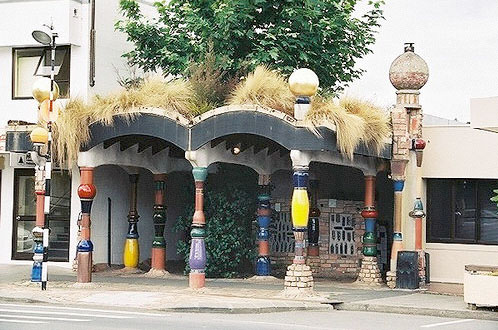
A bit closer -
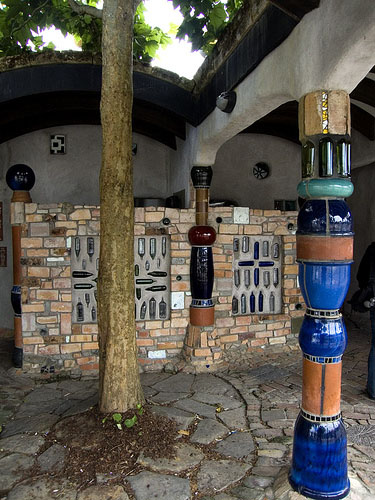
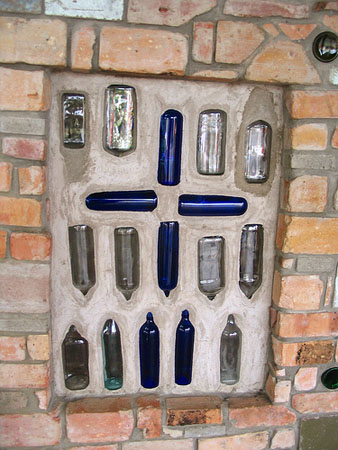
this is the view from the women's room
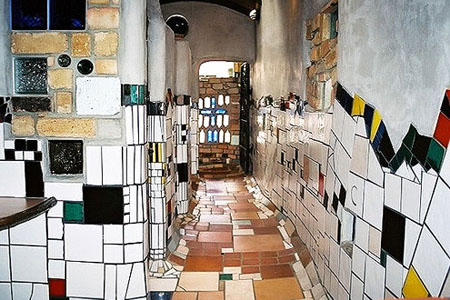
You can believe from these images that Hundertwasser was the man who said "criminal is the use of ruler and T-square in architecture" and "This jungle of straight lines, which is entangling us more and more like inmates in a prison, must be cleared."
this is the view from the men's room
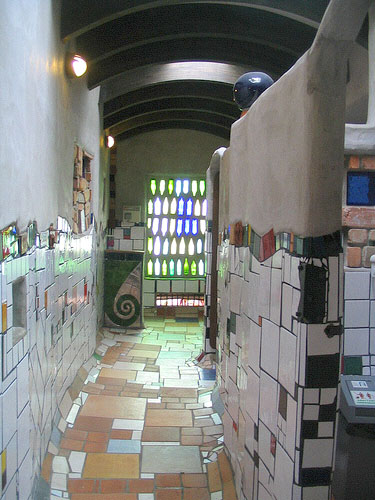
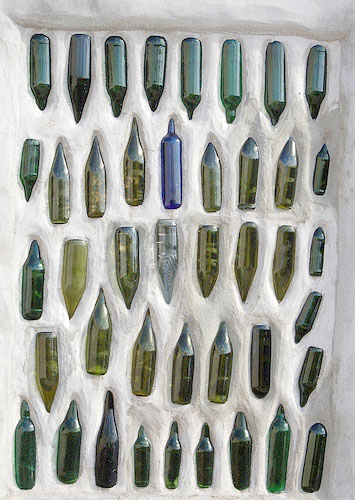
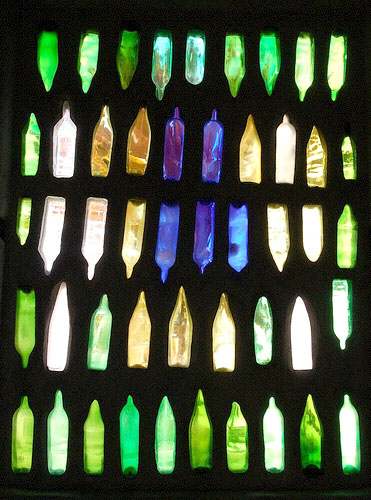
Market Hall, Altenrhein
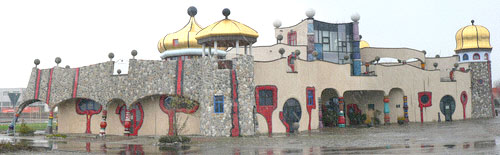
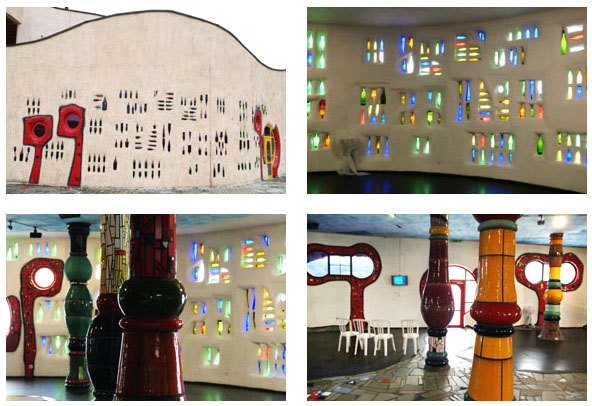
There is also, finally, this building called the Market Hall in Altenrhein, Switzerland that was done 'in the concept of Hundertwasser' not long after his death in 2000.
Flickr set on Markthalle by 'briethe