May 26, 2012
Joseph Cavalieri Interviewed by the American Craft Council
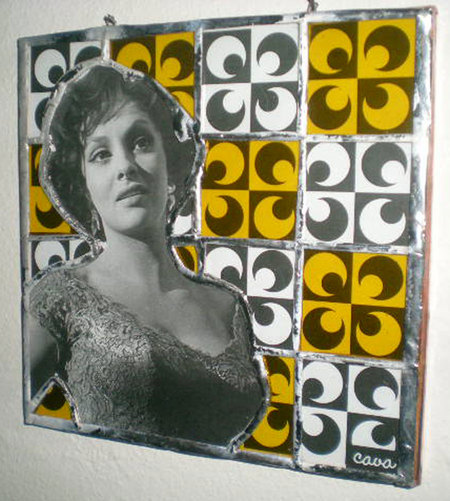
Stained Glass, Pop Icons, interviewed by Monica Moses, for the American Craft Council website. via twitterer @IGGAchat
Gina Lollabrigida in Giallo, by Joseph Cavalieri
January 23, 2012
Eldridge Street Window Featured in Traditional Building Magazine
Art Glass: Something Old, Something New, Something Blue, article by Art Femenella
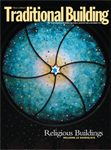
via the @BendheimGlass twitter feed
November 21, 2011
Art in Religious Context Award - Northumberland, UK
Tiny Tyneside church beats Canterbury cathedral and Gormley in arts competition, about the ACE Award for Art in a Religious Context from the charity Art and Christianity Enquiry (ACE).
Engraved glass so delicate that frost can change its nature helps scoop top prize for Northumberland. The Northerner's arts monitor Alan Sykes reports
Make sure to check out all the links. Very interesting.
Of the 2 winners, I think I like the Jame Hugonin piece the best.
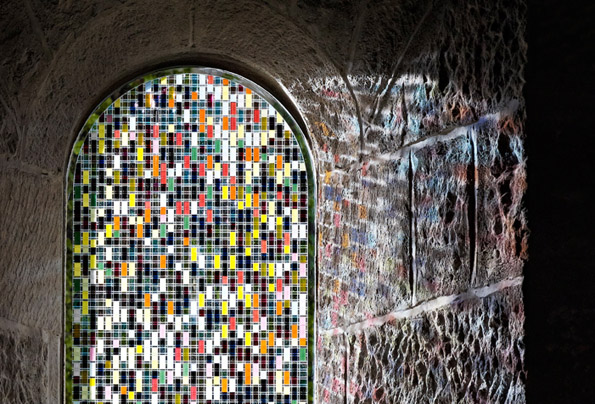
Contrary Rhythm (Glass)
James Hugonin, 2010
stained glass
St John's Chapel, Healy, Northumberland
photo via Ingleby Gallery
October 13, 2011
Handmade In Britain – Britain's Most Fragile Treasure
The documentary about the stained glass of York Minster, Britain's Most Fragile Treasure, aired last night in the UK. Possibly never to be seen in the USA, due to "Rights Agreements". Yeesh. Such is the indominable contrariness of the BBC in collusion with the American TV powers that be. Anyway.
To coincide with this, the York Glaziers Trust has set up a new York Glazier's Trust website, and it is quite impressive.
One interesting development I noticed is that the 'YGT' now has a conservation studio with real live stained glass conservators on view. I am curious to see how that develops. I'll keep my eyes and ears open for any first hand accounts.
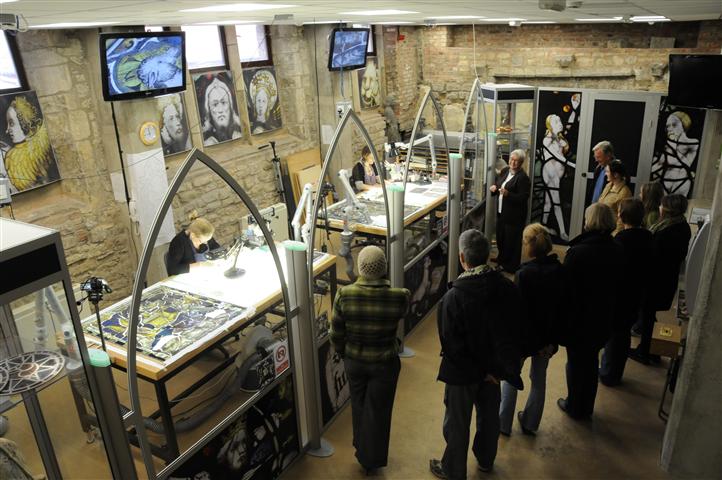
I believe the director, Sarah Brown, is the one conducting the group in the above picture. I met Sarah when she did a talk at the 2010 AGG concerence in Detroit. Nice lady, extremely knowledgable, and very dedicated to both the conservation of stained glass and the education of future stained glass artists and conservators.
They do great work there and I wish them the best of luck, especially in these austere times.
[update October 21, 2011 - this might be temporary, but Britain's Most Fragile Treasure is on YouTube now]
December 05, 2010
Eldridge Street Stained Glass on CBS Sunday Morning
Short segment on the Eldridge Street Museum stained glass window -
October 31, 2010
Art Institute of Chicago's Chagall Window Back on Exhibit
A Chicago Tribune article called "Chagall's 'Windows' returns" tells of the return of Marc Chagall's "American Windows" back to the Art Institute of Chicago.
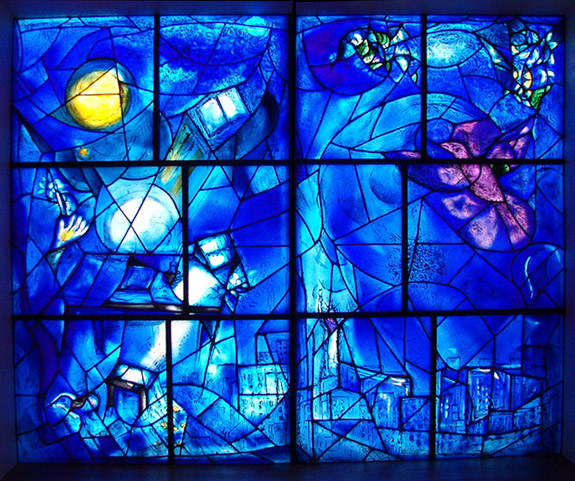
via flickrite clare_and_ben
There is also some kind of stained glass symposium called New Light—A Celebration of Stained Glass at the Art Institute, taking place at the AIC on Saturday, December 4, 2010. It looks to be a 4-5 hopur event, though there are no details given on content.
October 29, 2010
Heavenly Illumination
From the Guardian, an interesting article on chemistry in stained glass called Heavenly illumination: The science and magic of stained glass
October 21, 2010
Sylvia Nicolas Video
From Providence College You Tube Channel
There is a strong connection between Sylvia Nicolas and Providence College. She created the marvelous set of stained glass windows (45 in all) that chronicle the life of St. Dominic for the College's St. Dominic Chapel, which was dedicated in 2001. She also produced several sculptural works for the new Chapel—a Crucifixion and a series of reliefs showing the Stations of the Cross. The College awarded Sylvia Nicolas an honorary Doctorate in Fine Arts that year.
October 10, 2010
Museum of Eldridge Street Window Unveiled
Museum at Eldridge Street Glass Window, by artist Kiki Smith and architect Deborah Gans, is being unveiled this weekend. Make sure to look at the slideshow. It's not a traditional leaded construction, but flashed glass that is laminated with silicone.
Various articles and blog posts about the commission -
Monumental window for the museum at Eldridge Street, NY - Early concept sketches from a blogpost last January on dsgnwrld.com
Kiki Smith Brings a Stained Glass Big Bang to a Former LES Synagogue - ARTINFO.
Lower East Side Synagogue Unveils Stained Glass Window, WNYC Culture blog
Museum at Eldridge Street Hosts An Open House 10/10 - art.broadwayworld.com
Historic Synagogue Gets New Lease On Life - includes a 2 minute video piece on the window, from manhattan.ny1.com
[update Oct 18, 2010 - another New York Times article, including an interview with a woman doing a short documentary on the installation, with video - Video: A New East Window on Eldridge Street
October 01, 2010
Good News For York Glaziers Trust
In amidst the many reports of steep cuts in arts spending in the UK there is this small bright spot - York Minster gets £9.7m lottery funding boost.
I was fortunate enough to meet and talk with the director of the York Glaziers Trust, Sarah Brown, at the AGG Conference this summer, so I'm especially glad to see this.
Good news indeed.
August 24, 2010
Sylvia Nicolas in the news
Stained Glass Artist Sylvia Nicolas is in the news these days with a magazine cover story called The Sculpting of a Life, in the Parable Magazine, a magazine of the Diocese of Manchester, New Hampshire.

She also has an upcoming exhibit of her works at Providence College
Providence College called The World of Sylvia Nicolas - Painting, Sculpture, Stained Glass. The exhibition runs September 8th through October 22nd, 2010.
July 08, 2010
Cavalieri & Crumb - First Look
First glimpses of a very interesting project - Cavalieri & Crumb - as seen in The Brooklyn Paper
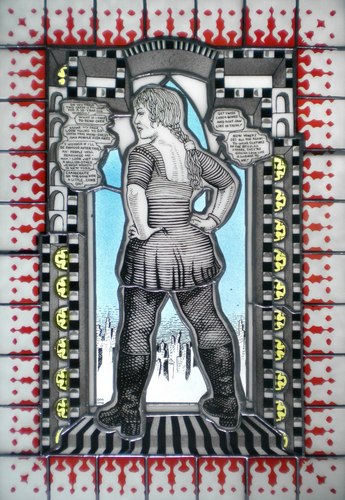
via creative commons - by Joseph Cavalieri, cavaglass.com
I've long thought that collaborations between 'stained glass artists' and 'comics artists' would yield some very unique and forward thinking results, so it's good to see some trying out the idea.
June 16, 2010
Inspirational Journey
More on Jon Kuhn's collaboration with Salem Stained Glass, and especially about Jon's upcoming presentation of one of his Sacred Cross series to the Pope.
June 04, 2010
The Art of Craftsmanship Revisited: New York
In the latest issue of the American Glass Guild newsletter, I created a page devoted to the involvement by stained glass artist Nancy Nicholson in something called "The Art of Craftsmanship Revisited: New York". There were only a few details about the program when I put that together. Well, now there is an official The Art of Craftsmanship Revisited: New York website, from Parsons and LVMH. The most interesting part to me are all the videos, including these two (plus 1) that are stained glass related.
Video on 'Stained Glass Artist' Nancy Nicholson. FYI: I've known Nancy from way back when, in the Boston days we worked shoulder to shoulder... 25 years ago now.
Craft Nouveau from Art of Craftsmanship on Vimeo.
I also found (on vimeo) this simple 55 second shot of Nancy's workspace panning over to see her working on the LVMH design. As much as I like the official edited piece on Nancy, I would love to see more of this.
Untitled from Conway L @ Parsons on Vimeo.
This is the video on 'Stained Glass Restorer' Thomas Venturella. I have met Tom, and I even visited his studio once, though it was almost 20 years ago.
T.R.E.M.L. from Art of Craftsmanship on Vimeo.
Artwork from The Art of Craftsmanship Revisited: New York, including Nancy's panel, is on display at Governor's Island, New York, on Saturdays and Sundays, June 5 - June 27, 11 AM - 5 PM.
If you want to get more exhibition details, plus the names of the student team award winners, check out The Art of Craftsmanship Revisited: New York official press release.
May 11, 2010
Kiki Smith's Lodestar
I've already noted that Judith Schaechter has a new gallery show coming up in New York. Well, there is another, even more prominent (to the New York art establishment) gallery show in New York featuring stained glass and it's alread y up and running. In this case the stained glass is by Kiki Smith, in an exhibit called Lodestar. I'd only heard about it vaguely, but I came across a video this morning.
I suspect that the video, short as it is, gives a better sense of the show than the rather unwieldy and flashy Pace Gallery website (why all the graying in and out boxes? Very distracting). More informative is the PDF press release for 'Lodestar', which has some interesting process photos, while she made the pieces at the Mayer Studio in Germany.
Small added bonus from the New York times is this Kiki Smith as Glass Artist Slideshow
May 05, 2010
Good News for Salem Stained Glass
My old stomping grounds, Salem Stained Glass, got some good news this week. Not many stained glass studios get an Audience with the Pope.
May 03, 2010
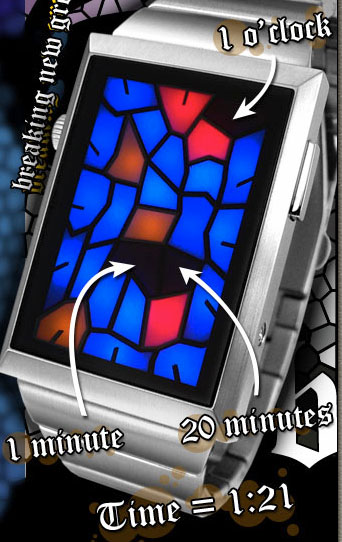
Kasai Broke
Stained glass referenced in the weird pop culture world of gadgets and gizmos, from a CNET article called Go medieval with stained-glass USB watch - a thing called the Kasai Broke USB charging LED watch. Oh yeah, and it would appear to be entirely unreadable, but apparently that is the company's specialty, all kinds of unreadable watches. Egad.
April 05, 2010
Judith Schaechter on Friday Arts
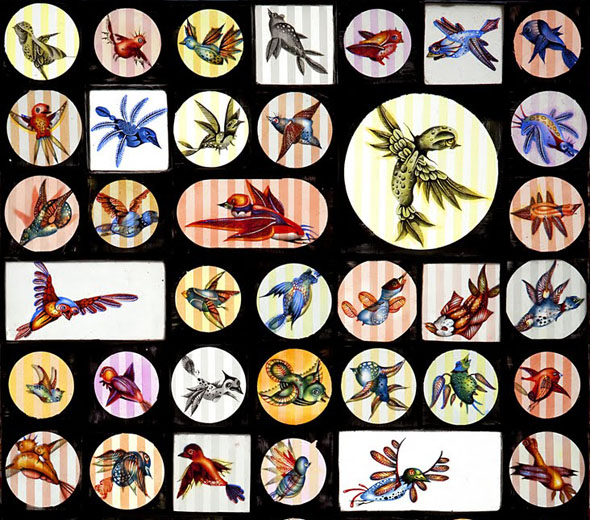
There is a video now available called 'Friday Arts for April 2, 2010' (no embed available), from a broadcast on Philadelphia Public TV. I'm not sure if they have any other name for it. No matter, since the only important thing is that the first section is about Judith Schaechter, contemporary stained glass artist extraordinaire. She starts at about a minute in and goes to about 7:25. Judith is just finishing work for a new exhibit at Claire Oliver Gallery, opening May 22. The new pieces look amazing, upping both the technical and graphical limits of her work. She's been updating the progress of these panels regularly on her blog, Late Breaking Noose. Go back several months and check them all out. Well worth it.
Detail, The Minotaur, stained glass panel, Judith Schaechter, 2010
December 08, 2009
New Medieval Galleries at the V&A
The reviews are coming in for the newly reopened Medieval and Renaissance Galleries at the Victoria and Albert Museum (commonly known as the V&A) in London, England. This review of the V&A's Medieval & Renaissance Galleries in the Telegraph is pretty typically glowing.
But I'm not so sure. The collection is amazing, truly one of the very best in the world. But from the photos I've seen of the exhibition space, something strikes me as wrong.
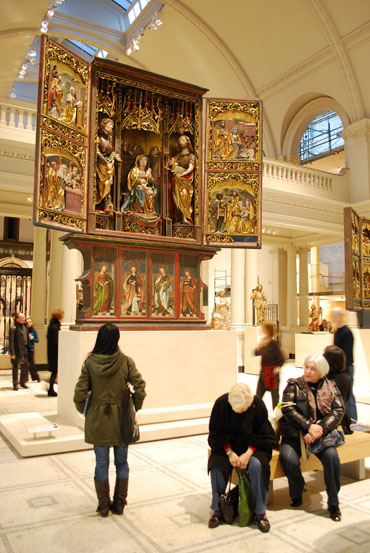
Flickrite Sam the Sham and the Photos
My first uneasy impression - Why all the white?
A minor rant and a few more images below the fold...
Butterfly Collection versus Theme Park Ride
The V&A collection of medieval art and stained glass is one of the best in the world. But I do wonder if the reviewers are praising the collection and not the exhibition. This video from the Guardian was the first thing I saw of it and it shows lots of the white walls in a very brightly lit space.
My concerns about the white space started to clarify when I read this article from the Guardian website, with the curious title of In this mist of antique loveliness, the object is all. For history go elsewhere. In the article Simon Jenkins praises the exhibition while also pointing out the issue of context. He contends that the V&A has a fear of putting the art works in any kind of context. That nay context would turn the whole exhibit into a theme park ride, tagging it with the dreaded title of 'Disneyland'.
I contend that the V&A has gone too far in the other direction and the whole thing comes off as a terribly stark and sterile, brightly-lit butterfly collection.
In the end, Simon Jenkins suggests it's not that important and his only response is 'museums can't do everything'.
I would argue that surely there can be some kind of compromise between the butterfly collection approach and the theme park ride approach. Maybe even start by getting rid of the harsh snarky metaphors.
One area where I would hope there could be compromise is with light levels. In the new modern approach, the light levela seem way too high. Can that be toned down without losing integrity?
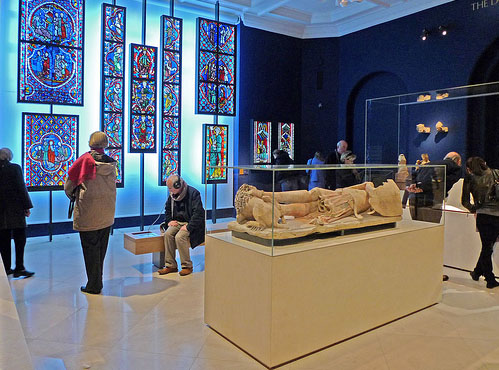
Flickrite Where the Art is
This lightbox setup for the stained glass is especially galling. To see the amazing V&A collection of stained glass just popped in front of a big single stark white plexiglass light box chills my spine. At least some of the stained glass is placed in individual light boxes so you are not seeing the panels with a stark white light surrounding them, though there is still a stark white wall. Was there any attempt to find a way to display this incredible collection in natural light?
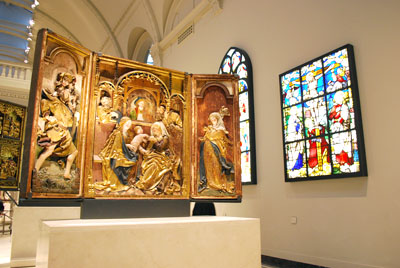
Flickrite Sam the Sham and the Photos
Obviously, I reserve final judgement on seeing the new galleries in person, but I'm concerned that the concept of how to display these works of art was ill-conceived. From what the Jenkins articlel suggest, it's from the fear of looking like a theme park. My own hunch is that 'light, bright and airy' modern museum spaces are easier to sell than dimly lit medieval spaces in our day and age. So they fit the medieval collection to what people expect in a modern museum, which means light and airy atrium spaces.
Personally, I wish they had designed the space to fit the needs of the collection, not the marketplace.
December 07, 2009
Buzz is good
Joseph Cavalieri is catching some blogosphere buzz over his Simpsons Series.
November 06, 2009
ReadyMade talks to Judith Schaechter
Nice post on the ReadyMade website called Stained Glass in Philadelphia: A Visit With Judith Schaechter in Sad City
There is also a 4 minute video where Judith shows off her layering techniques. I tried to embed the video, but it didn't play well. In fact it almost locked up my whole computer. I can only guess they uploaded a video without compression or something similar. Anyway, here is the link to Ready To Wear's Judith Schaechter YouTube video.
September 29, 2009
Squares of Somerville
Posted on YouTube today (though not embeddable) - Ball and Magoun Squares, Somerville from the local TV news magazine, Chronicle, in the Boston area. The piece includes a mini portrait of the Dan Maher Stained Glass studio, in Magoun Square.
The video as a whole is only 3 and half minutes long. Dan is in there from 1:45 to about 3:15. Some little highlights - At 2:10 you see a glimpse of his making one of his Houseware Graveyard pieces. You can see the chunky pieces wrapped in lead came being assembled on the table. At 2:40, the two people in the photo-sandblasted piece are Nancy and Joe Barnes. And finally, note in the long shot of his front window, at the bottom are some of his hand blown rondels. Very nice.
I lived in Somerville for nearly 6 of the 18 years I lived in the Boston area, and Somerville really is a great place for small city squares like this.
September 27, 2009
LIFE on Google Books
Boy, could I waste a lot of time here....
As of last Wednesday every issue of LIFE magazine from 1936 to 1970, almost 1900 issues, is available to read on Google Books. I've commented on the Google LIFE Photo Archive before. This is similar, only the full magazine stories give a much better historical context. Seeing that LIFE was big (almost 11" x 14"), LIFE on Google books has an especially clunky interface to look through, but the sheerly amazing content makes it worth the slog. I spent part of a day searching for stained glass related stories.
A quick look, but some curious finds, below the fold...
April 3, 1939 -
Stained Glass has U.S. Renaissance, focusing on the Wilbur Herbert Burnham Studio, out of Boston. This issue came out just a few months before war broke out in Europe. In this context the weird society photo of Hermann Göring and the long profile of Charles Lindbergh in his "America First" days, seem especially curious.
September 11, 1939 -
Art in Wartime, a brief piece with 2 images about the removal of stained glass from Canterbury Cathedral. This issue is an especially interesting one historically, seeing tha it was published just 10 days after the second world war was declared in Europe. Interesting and kind of creepy, seeing how many of the stories come off as pro-Germany, or pro-Fascist. Mussolini is on the cover, and there is a lengthy, and relatively positive, close-up profile of Hermann Göring, Hitler's second in command. There is also a mention of the American "Nationalists", who advocated that America take the side of Germany rather than England or France. Kind of frightening, actually.
April 6, 1942 -
A Dutch Artist Designs Windows for U.S. Church, about the work of Joep Nicholas. Features some nice color photos. This article shows how the mix of ads and photos could be a bit jarring in some issues of LIFE, as you scroll down from images of stained glass windows depicting "Palm Sunday" and "The Last Supper", then down to "The Crucifixion" and "The Resurrection", only to go directly into a glamour photo showing "Life's Sweetest Moment, with Palmolive Beauty Oil Soap". Some things words cannot describe...
March 20, 1950 -
An issue with a feature about 19 Young Americans, which is about 19 American artists under the age of 40. None of whom, I must add, I'd ever heard of before, with the exception of Sigfried Reinhardt, who eventually would design stained glass windows from his home in St. Louis, Missouri.
March 24, 1952 -
Reinhardt was featured again in LIFE two years later, in a piece called Young Painter's Progress.
June 19, 1950 -
More modern stained glass in LIFE, this time about The Assy Church - Famous Modern Artists Decorate Chapel in Alps. Features some nice color photos, including one of a Rouault window translated by Paul Bony.
May 10, 1954 -
From a special issue called Germany - A Giant Awakened (what's with the German obsession?) there is a picture of Georg Meistermann as part of a feature called Outburst of Art - Post-War Art in Western Germany.
October 25, 1954 -
An article called A Left Bank in New York, about French artists immigrating to New York, including stianed glass artist Robert Pinart. Again, I can't say I've heard of any of the other artists.
Granted that this is ust a quick search, but it is odd, all in all, that after WWII, there is so little about American stained glass.
September 26, 2009
Euronews on Stained Glass Conservation at Cologne Cathedral
A video posted today by Euronews, centered around the conservation of stained glass at Cologne Cathedral.
At the risk of sounding like an aging curmudgeon, I'd say there is a bit of an overemphasis on the technological marvels of scientific tools and procedures. Call it "CSI: Stained Glass Unit". It makes for great TV images, but most stained glass conservation, even on great landmarks, is much more low tech and mundane.
There is a website given at the end for Constglass, which is supposed to be an acronym for "Conservation Materials for Stained Glass Windows - Assessment of Treatments, Studies on Reversibility, and Performance of Innovative Restoration Strategies and Products". What there is seems fine by me in terms of good sound conservation practices, though it is hard to tell, what with the cryptic lingo used throughout the site, as in this page called Project Methodology.
September 16, 2009
John LaFarge at Vareika Gallery
An article called Newport art gallery features stained-glass windows of John La Farge from the Providence Journal website. The gallery in question is William Vareika Fine Arts, Inc., of Newport, Rhode Island.
I would highly recommend you scroll down on their website and download the exhibition catalog as a pdf - 40 pages and 78 full color photos. Specifically, photos of all the stained glass on display plus dozens of LaFarge watercolors, many of them designs for stained glass. Wonderful.
I visited the Vareika gallery once, about 12 years ago, to see the LaFarge watercolor sketches for stained glass. They didn't have any stained glass panels on display back then, so this would definitely be worth a special trip.
[update - later the same day...] Funny. After I did this initial post, this video showed up on YouTube, via Salve Regina's YouTube channel - La Farge Window Restoration-Our Lady of Mercy Chapel
September 12, 2009
euromaxx highlights - Peters Studio, Germany
The show as a whole is a bit too TV-slick for my taste, but there is a segment toward the end about Peters Studios, a large multi-generational stained glass studio in Germany. The part about Peters is from 18:50 to 22:30 in the video. Beware, it may play slowly on an older computer.
All in all, a brief but interesting glimpse into a modern German studio.
August 29, 2009
Beware The Fabian Window... Or Not.
How does a 99 year old English stained glass window figure into American politics today? Well, of course... it doesn't.
But that is the contention of a Canadian conservative website, in two articles with the titles Barack Obama's Fabian Window, and Beware Obama's Fabian Window.
I hesitate to link to these articles since they are so much a part of the nonsensical, conspiracy prone, knee-jerk conservatism that is running rampant at the moment, and to point to them seems to give them a credence that they do not merit.
But come on... this is pretty funny. Both funny/strange and funny/haha.
Even without the crazy conspiracy types projecting Barack Obama into the mix, the Fabian Window is still an interesting panel. See for yourself. Personally, the sinister conspiracy alludes me.
The Fabian Window, circa 1910
Designed by George Bernard Shaw
Fabricated by Caroline Townshend
click on the picture to see a larger image, in a separate window -
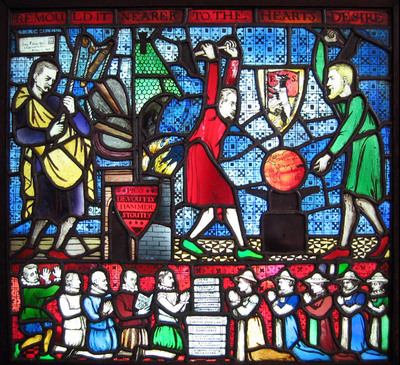
photo by flickrites Ruth and Dave
From April 2006, a BBC news magazine article called, Wit, wisdom and windows, on the unveiling of the Fabian window at the London School of Economics, where it now resides.
This is a listing of the people depicted in the window, from the London School of Economics web page -
The first man, crouching on the left, is HG Wells, shown cocking a snook at the others, after a disagreement with fellow Fabians. He is followed by the actor-manager Charles Charrington, Aylmer Maude (translator of Tolstoy’s War and Peace), G Stirling Taylor (reading a book, New Worlds for Old), and the dentist F Lawson Dodd. The women, from left to right, are Maud Pember Reeves (mother of Amber Reeves, who bore Wells a daughter in 1909), Miss Hankin, the suffragist Miss Mabel Atkinson, Mrs Boyd Dawson, and, at the end, the artist who made the window, Caroline Townshend herself.
The stained glass artist who made it was Caroline Townshend. She is depicted in the window in the lower right corner of the. Here is a blog post about some Sketches by Catherine Townshend, and a nice Flickrset of Caroline Townshend Windows by Flickrite davewebster14
July 02, 2009
Made In America visits Franklin Art Glass
Posted recently on YouTube - a very nice professional take on Franklin Art Glass, out of Columbus, Ohio. The program "Made In America" was (is?) shown on The Travel Channel, hosted by John Ratzenberger.
It's about 8 minutes long - not sure when it was filmed or aired (best guess right now is 2008).
I never knew there was a "Wendy's" connection with Franklin Art Glass...
I'd never heard of "Made In America", perhaps something to do with my not having CableTV for 15 years and no TV at all now. There were apparently at least four seasons of episodes and there is a DVD with 20 episodes, with perhaps more to come. Whatever the whole series is like, I do like the idea of a series about the importance of making things for yourself and your own culture, whether it's about America or any other country. Making things really is a vitally important part of any national/cultural identity, and that identity is indeed in serious crisis in America.
One especially intriguing bit in the film for me (at about 2:50) - seeing the little snippet showing Wissmach's machine rolled glass making process.
more more, please more.
June 24, 2009
Jon Kuhn and Salem Stained Glass
I've been busy recently and I'm only now catching up with this press release from about 4 weeks ago - New Technique Promises to Revolutionize Traditional Stained Glass Windows. The press release announces a collaboration between the glass sculptor Jon Kuhn and Salem Stained Glass.
The press release has generated some buzz. On the AGG bulletin board, there has been an ongoing discussion thread called Cold Glass Artist Jon Kuhn. A smaller thread with some better images of the sample 'Sacred Glass' pieces can be seen on the SGAA forum thread called Kuhn cold glass artist and traditional stained glass.
The press release also brought about this a recent article called Jewels' of Glass: Salem Stained Glass, Winston-Salem glass artist create works to tap into upscale residential market, from the Winston Salem Journal website.
Promotional video for 'Sacred Glass'
full disclosure - I worked at Salem Stained Glass for 3 years (2001-2004), with 2 of those as production manager. They're good people and they do good work. Plenty of flashbacks seeing the shop in the video.
More on Kuhn's work (including another video) and my own take on the collaboration, including a few caveats, below the fold...
Though I never met him or visited his studio when I lived in North Carolina, I've been familiar with Jon Kuhn's work for nearly 20 years. I first saw it on display at the Victoria & Albert Museum in London. I find it pretty dazzling though I think I prefer the basic cubes over the later more elaborate shapes. See for yourself. If you haven't seen his work, the best intro I've come across is this YouTube video of Jon Kuhn at the Hawk Galleries. It's about 8 minutes. He talks about his background and techniques, and plenty of his work is shown.
So - what's my honest impression of all this? Basically, I believe that the idea of studio glass artists collaborating with stained glass artists is a very good thing and I would encourage it anytime. Too many stained glass artists live in a bubble, with little interest in art forms outside of what they do.
That said, I do see some challenges for this particular collaboration. Not insurmountable, of course, but the issues are there nonetheless.
1) The Aesthetic Disconnect - a.k.a. the transmitted light thing.
Kuhn's work is sculpture. Though transparency is a key element, it is mostly dependent on reflected light, that is, with the lighting bouncing off the sculpture and back at you. Whereas stained glass windows are mainly, sometimes totally, dependent on transmitted light, with the effect coming from light traveling through the glass to your eyes. I tend to think that elements included in stained glass that rely on reflected light for full effect don't work well incoporated into stained glass.
Will that prove to be a factor here? How will the intricate inclusions look next to the factory created sheet glass? Will the complex crystaline pieces look odd next to factory made sheet glass, especially machine rolled opalescent? Impossible for me to say until I see the actual panels and not just images on the web.
2) The Price Points.
The prices quoted in the press release are very high. The sample they site, $20,000 for a 24" x 37" panel, comes in at more than $3200 a square foot. I know Kuhn gets big bucks for his sculptures, but those buyers are studio glass collectors, not churches. I have seen a few instances where churches will pay a much higher price for the prospect of getting a 'name recognition' artist, but the notion of getting more than $3,200 a square foot for stained glass is a bit hard to believe, at least in this economic climate. Most studios I know of start at around $150-200 a square foot for the simplest of designs (with even lower starting price points in the Southeast) and go upwards of $500-1000 a sqaure foot for more complex work. I suspect the Kuhn/Salem team would do best going for the high end residential market, rather than churches.
3) The Longevity of Laminated Glass in an architectural setting.
The comments on the AGG board mostly honed in on the prospect of Kuhn's laminated pieces not being able to withstand the test of time technically. That the lamination will fail, especially if subjected directly to varied weather conditions. Indeed, laminated pieces are still a question mark over a long period of time. Kuhn's sculptural work has always been in gallery and museum settings, not subjected to extremes of temperature, humidity, precipitation or wind. It might not be such an issue if they were not stating in the press release - 'I want my panels to last forever'.
May 29, 2009
Stained Glass Day at the Met
On Sunday, May 31, 2009, there will be a day of talks on stained glass at the Metropolitan Museum of Art in New York City, all part of celebrating the opening of the newly refurbished American Wing.
Officially it's called Sunday at the Met—An Old-World Art Form for the New World: Issues in the History of Conservation, Collecting, and American Designs for Stained-Glass Windows.
Whew.
May 20, 2009
Connick Tour in Pittsburgh
An article called Shining a light on stained glass artists, about Charles Connick's stained glass in the Pittsburgh area. This coming Sunday there will be the first in a series of lectures and tours related to Connick stained glass.
Not from Pittsburgh, but a nice early Connick piece I found on Flickr.
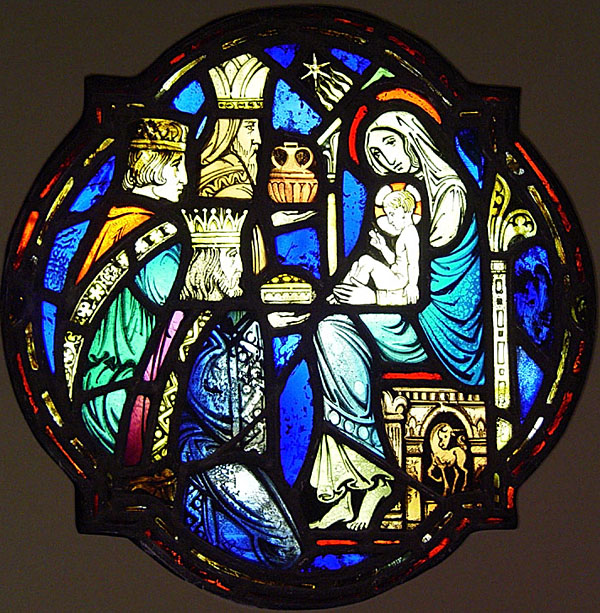
Adoration of the Magi, LACMA, from flickrite howcheng
May 12, 2009
Met's American Wing Galleries to reopen May 19
The Metropolitan Museum of Art, New York City, is announcing the reopening of the Metropolitan Museum of Art's American Wing.
One of the windows going back on display is The Welcome Window by John La Farge, which is in my opinion one of La Farge's very best windows. The roses on the steps, when seen up close, are just astonishing.
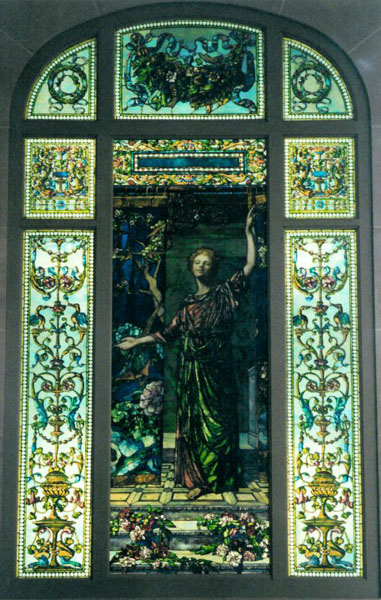
from flickrite miai c
Entire press release below the fold -
New American Wing Galleries Open May 19
Reconfigured Charles Engelhard Court, Balcony Galleries, and Historic Rooms Represent Second Part of Multi-Year Construction Project
Opening: May 19, 2009
Press Preview: NEW DATE: Thursday, May 14, 10:00 a.m.–1:00 p.m.
When The Charles Engelhard Court—the grand, light-filled pavilion that has long served as the formal entrance to The Metropolitan Museum of Art's American Wing—reopens this spring after two years of construction and renovation, the Museum's unparalleled collections of American ceramics, sculpture, stained glass, architectural elements, silver, pewter, glass, and jewelry will finally be seen in all their glory. So, too, will its early American rooms—12 of the Met's historic interiors, mostly from the colonial period, located on three floors of the wing's historic core—that have been reordered, renovated, and reinterpreted. The popular American Wing Café will also reopen in its previous location on the park side of the court. The opening of the galleries marks the completion of the second part (begun in May 2007) of a project to reconfigure, renovate, or upgrade nearly every section of The American Wing by 2011.
Morrison H. Heckscher, the Lawrence A. Fleischman Chairman of The American Wing, described the project as "architecture in the cause of art." He continued: "The goal of the comprehensive renovation of The American Wing is to present the Museum's superlative collections in the clearest and most logical, as well as most beautiful, manner possible. Toward that end, we have called upon the building itself—in the use of clear glass for walls and parapets and even a new public elevator, for example—to provide visual access to all facets of the collections."
The Charles Engelhard Court
Upon entering The Charles Engelhard Court, visitors will immediately encounter a new display of some 60 examples of large-scale sculpture, mosaics, stained glass, and architectural elements. The monumental sculpture collection will be installed on a new main-floor level—near the stunning loggia designed by Louis Comfort Tiffany for the main entrance of Laurelton Hall (about 1905), his Oyster Bay, Long Island, residence—as well as on a lower level in front of the façade of Martin E. Thompson's Branch Bank of the United States (1822–24), originally located at 15 1/2 Wall Street in New York City. Included will be marble and bronze figurative works by such American master sculptors as Hiram Powers (1805–1873), Augustus Saint-Gaudens (1848–1907), Harriet Whitney Frishmuth (1880–1980), and Paul Manship (1885–1966). These familiar works have been reinstalled in new groupings to encourage aesthetic and thematic comparisons and allow viewers unprecedented up-close access. Notable is the relocation of the marble Milmore and Melvin memorials by Daniel Chester French (1850–1931) from the balcony to the first floor, where they can be appreciated in proximity to other superlative American Beaux-Arts sculptures. The popular pool feature has been redesigned to showcase two bronze fountains by Frederick William MacMonnies (1863–1937) and Janet Scudder (1869–1940) that are piped to spout water. John La Farge's ambitious allegorical Welcome Window (1908–9)—a virtuosic work in stained glass—will be installed next to Saint-Gaudens's marble-and-mosaic tour de force Vanderbilt Mantelpiece (1881–83). American neoclassical marbles of the mid-19th century will return to the courtyard, displayed in a distinct group between a new seating area and the Branch Bank façade.
Balcony Galleries
The American Wing's outstanding collections of ceramics, glass, silver, and pewter will be installed in the balcony galleries in an integrated chronological sequence, beginning with the colonial period on the east side and continuing into the 20th century on the west, overlooking Central Park. Individual cases will be arranged by medium or theme. Among the highlights of the silver display will be the work of such familiar names as Paul Revere, Jr., and Tiffany & Company. A newly constructed mezzanine-level balcony, accessible via a staircase in the northwest corner, will be devoted almost entirely to the display of a major recent acquisition—250 superb examples of American art pottery crafted between 1876 and 1956, a promised gift of Robert A. Ellison Jr.—that has never before been publicly seen. Stained-glass windows of the same period, by Frank Lloyd Wright (1867–1959), William Gray Purcell (1880–1965) and George Grant Elmslie (1869–1952), and George Washington Maher (1864–1926) that incorporate large amounts of clear glass will also be installed nearby, with Central Park visible through them.
Additional stunning examples of mid-19th-century ecclesiastical stained-glass windows, installed on the upper balcony to allow for close examination by visitors, will be visible from the courtyard, approximating their original vantage points. Work by every major designer of American stained glass will be represented in this display, the most comprehensive presentation in any American museum.
In all, nearly 1,000 works of art will be exhibited, including two new cases devoted entirely to American jewelry, ranging from early 18th-century mourning rings to surprising works of the Arts & Crafts period. From the courtyard below, the new glass-fronted balconies will reveal a panoply of color, form, and brilliance.
Period Rooms
The American Wing's 20 period rooms—19 of which return to view this spring— provide an unparalleled view of American domestic architecture and interior design over three centuries. Twelve rooms, dating from 1680 to 1810, have been newly renovated. The new installation also involved the removal of several interiors of minor interest, the relocation of two 18th-century rooms (the Verplanck Room, 1767, and the Marmion Room, 1756), and the addition of one new room—from the 1751 Daniel Peter Winne house near Albany, New York—which will be among the rooms opening this May. Built in the Dutch architectural tradition, the Winne Room will be used as a gallery for the display of the Museum's superb collection of furniture, silver, painted glass, and early portraiture made and used in the Dutch cultural areas of colonial New York.
With the renovation of the period rooms, visitors will be able to take a complete tour of American interiors and decorative arts in chronological sequence, from the 17th century (the Hart Room, 1680) to the 20th century (the Frank Lloyd Wright Room, 1912–14). A new glass elevator will carry visitors directly to the third floor, where the earliest rooms are located.
Recent research has led to changes in the appearance or interpretation of several of the rooms.
Touch-screen computers will allow the public to access many layers of information about each room, with sections on the objects that are displayed in it, the architecture of the house that the room came from, the original owners, and the history of the room and its installation after it came to the Metropolitan Museum.
The rooms on each floor surround three main decorative arts galleries, which will be newly installed with fine examples of American furniture and portraiture. These will include masterpieces by 18th-century cabinetmakers such as John Townsend of Newport and Thomas Affleck of Philadelphia, and 19th-century counterparts Duncan Phyfe and Charles Honoré Lannuier of New York.
The Erving and Joyce Wolf Gallery
Located within The American Wing, The Erving and Joyce Wolf Gallery is one of some 20 spaces at the Museum specifically designed to accommodate several special exhibitions per year. As part of this second phase of renovations, new wood floors and new lighting were installed in the space. The first exhibition to be housed in the renovated gallery is Augustus Saint-Gaudens, opening June 30, 2009.
The final phase of the American Wing renovation project will include the American paintings and sculpture galleries and the addition of eight completely new galleries for the display of the Museum's superb collection of this material.
Related Programs
A variety of education programs will be offered in conjunction with the New American Wing galleries opening this May, including: a May 30 afternoon of lectures in the Sunday at the Met program; gallery talks focusing on the variety of media and styles of art on view; family programs for children ages 5-12 and accompanying adult; and workshops for adults with visual impairments, as well as for families with children and adults with learning and/or developmental disabilities.
Special online features about The American Wing are available on the Museum's website (www.metmuseum.org).
Audio Guides for The American Wing will be available. Forty-two new audio messages, featuring conversations with American wing curators, will be produced about the works in the new galleries. The fee for rentals is $6 for members of the Museum, $7 for non-members, and $5 for children under 12.
The Audio Guide program is sponsored by Bloomberg.
The popular American Wing Café will reopen May 19 in The Charles Engelhard Court, serving traditional American favorites. Its hours are 11:00 a.m. to 4:30 p.m. Sunday, Tuesday, Wednesday, Thursday; and 11:00 a.m. to 8:30 p.m. Friday and Saturday.
Credits
The project is under the general direction of Morrison H. Heckscher, the Lawrence A. Fleischman Chairman of The American Wing, and Peter M. Kenny, Curator of American Decorative Arts and Administrator of The American Wing. The installations within The Charles Engelhard Court were coordinated by Alice Cooney Frelinghuysen, the Anthony W. and Lulu C. Wang Curator of American Decorative Arts, together with Beth Carver Wees, Curator of American Decorative Arts, and Thayer Tolles, Associate Curator of American Painting and Sculpture. The period room installations were overseen by Amelia Peck, the Marica Vilcek Curator of American Decorative Arts. The overall project architect is Kevin Roche John Dinkeloo and Associates LLP; the Engelhard Court installations are by Michael Lapthorn, Exhibition Designer; the period room installations are by Stephen Saitas Design; and lighting is by Richard Renfro Associates.
Conservation of works of art in all media was carried out under the general direction of Lawrence Becker, Sherman Fairchild Conservator in Charge, with Linda Borsch and Marijn Manuels, Conservators, and Drew Anderson, Associate Conservator, all of the Department of Objects Conservation.
The Metropolitan Museum gratefully acknowledges the following lead contributors to the project: Margaret and Raymond J. Horowitz, Anthony W. and Lulu C. Wang, Mr. and Mrs. Richard L. Chilton, Jr., The Peter Jay Sharp Foundation, Juliana and Peter Terian, Jan and Warren Adelson, Max and Heidi Berry, Ambassador and Mrs. W. L. Lyons Brown, Joyce Berger Cowin, Jane and Maurice Cunniffe, Barbara G. Fleischman and Martha J. Fleischman, Peggy N. and Roger G. Gerry Charitable Trust, The Henry Luce Foundation, Elizabeth and Richard Miller, Oceanic Heritage Foundation, Doris and Stanley Tananbaum, and Barrie and Deedee Wigmore.
# # #
April 28, 2009
April 23, 2009
Smithsonian Craft Show starts TODAY
As I posted about last December, friend and colleague Nancy Nicholson is in this year's Smithsonian Craft Show, which starts today and goes through next Sunday.
As I said before, it's big news, as it's pretty rare for a stained glass artist to make it into the show. I was in the 2000 Smithsonian Craft show and it was a great experience, and I'm still getting commissions from that show.
I'm with you there in spirit, Nancy. Good Luck!!
If you're in Washington DC this weekend, make a point to go!!
April 17, 2009
Dana Thomas House to reopen soon
Good news for fans of the stained glass of Frank Lloyd Wright -
One of the most significant sites for Frank Lloyd Wright stained glass, the Dana-Thomas House in Springfield, Il, is to re-open soon. It was closed last year due to budget constraints.
from the mystateline.com article Some Historic Sites To Reopen Soon -
Blanchette says there's no word yet on which locations will reopen but says that the Dana-Thomas House in Springfield, the Lincoln Log Cabin near Charleston, and other popular places will probably come first.
April 15, 2009
Made for Manufacture Exhibit at the Getty
via Twitter - first time! - but so new to it that I don't know how to link to the individual "tweet", or even if I can -
It is curious that stained glass is given its own category in this Getty Museum exhibit called Made for Manufacture. I like the idea of the exhibit as I always love seeing original working drawings for stained glass, or any other 'manufactured' artwork for that matter.
for example - all these stained glass cartoons available on Wikimedia - including this Design for a Stained Glass Window for Christoph von Eberstein, by Hans Holbein the Younger.

Fascinating.
I tried a Google search for "working drawings stained glass" and found very little. The best example, IMHO, was from a page about 'The Process', by stained glass artist Alice Johnson. Full disclosure - I created the webpage and Alice is a good friend (and excellent stained glass artist).
As for anyone who sees the Getty show, give me a shout.
April 09, 2009
Rowan LeCompte on NPR this Saturday
via the AGG discussion board -
Renowned artist and AGG Senior Advisor, Rowan LeCompte, will be interviewed by host Scott Simon on Saturday's National Public Radio (NPR) program (4/11/09). The segment is expected to air between 9:30-10AM.
Rowan LeCompte is best known for his work on Washington's National Cathedral. If you are unfamiliar with Rowan's work, check out the recent article in the Washington Post called God in the Details.
I'll link to the NPR interview page when it's online.
[update1 4/11/09 -the NPR page is up and called Stained Glass Artist Lets The Light Through At Last, by Justine Kenin.]
[update2 - There is also video of Rowan called Let There Be Light that is in the works from a company called Global Visions.]
[update3 - I didn't get a chance to hear the interview until it came on the web this afternoon. Too brief, as usual, but a very nice interview. It's worth looking through the comments to the story as well. The passage that people seem to have picked up on the most is regarding Scott Simon's question as to whether Rowan believed in God and on Rowan's response -
"I believe in Kindness and Love. And there are those who say that those are God. I don't know, but I respect and love Kindness and Love, and worship them. And if I'm worshiping God, I'm delighted."
It's a nice, open-minded sentiment and I'm glad he put it that way. I met Rowan once briefly, but never had a chance to talk with him at length, so I never got to see this side of him. Thanks to Scott Simon and NPR, I've gotten a glimpse.]
March 30, 2009
Major Commission Awarded via Student Contest
via design observer -
Article in the Washington Post called 'Students' Crowning Glory - Two Catholic University Freshmen Win Contest to Adorn D.C. Basilica's Dome'.
It seems to me that with a 100 foot mosaic dome plus 36 stained glass windows, it's a pretty massive commission to entrust to a University student competition. Committees and student contests? Am I missing part of the story? Is this more like a sideline student contest where the winner was never intended to be the final design? The text does state that "Although the basilica is free to change their proposal or commission another one, the contest represents the first step toward completing the church's largest dome". What does that mean? I guess it's the headline that makes it seem like these students have gotten the commission.
The First Place design is at least the best of the group shown in the picture gallery -
from the Photo Gallery
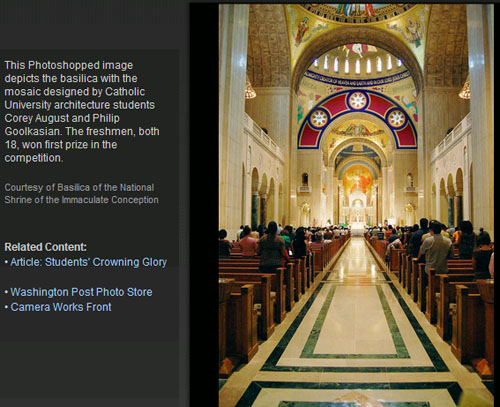
A nice, if conventional, design.
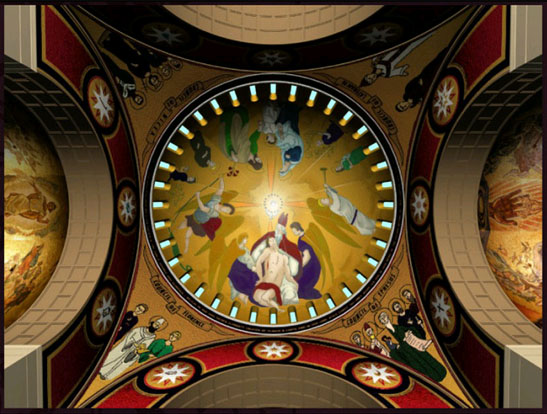
The Second Place design looks like a student design, especially on closer examination. There's a rushed, slapdash quality about it, perhaps not surprising considering the time pressure.
from the Photo Gallery

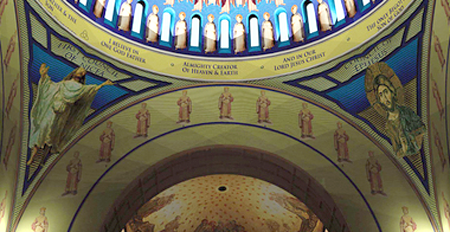
Notice the figures along the arch. This is pure cut and paste photoshop work. Is the intention really to make them all rubber-stamp identical? Or are we supposed to assume there will be some differentiation if this were the final design.
Now look at the figure on the right. It's the mosaic design of Jesus from the Hagia Sofia just sort of arbitrarily stuck in. Somehow I don't see this as any kind of conscious and sophisticated postmodern mashup (though I grant that it could be seen as an unconsciously sophisticated postmodern mashup). I suspect it was just quicker and easier to grab an old mosaic Jesus and pop it in there.
Hagia Sophia mosaic Jesus

Maybe these are meant as rough, general sketches that will be fleshed out later. Or maybe the article is making more of the contest than it was intended to be. In any case, it seems an odd way to design the artwork for a major building project, and an odd way to promote the design process. Let's hope there is more to the story.
March 24, 2009
CraftBoston 2009
CraftBoston Spring 2009, is happening this coming weekend, March 27-29, 2009. This event continues to feature more flat glass artists than your average high quality craft show. There are, on quick glance, at least 3 that could be called stained glass artists, and another 2-3 fused glass artists - and it's all good stuff...
Daniel Maher, Stained Glass
I'm appearing with Dan this summer at the 2009 American Glass Guild Summer Conference, in a talk about our different uses of screenprinting/photosandblasting.
One of Dan's photosandblast pieces - amazing stuff...
Trinity Portrait
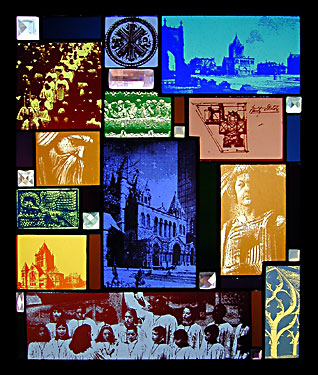
Kate Gakenheimer, Stained Glass - as always, love the pattern work.
Rachel's Yuzenzome
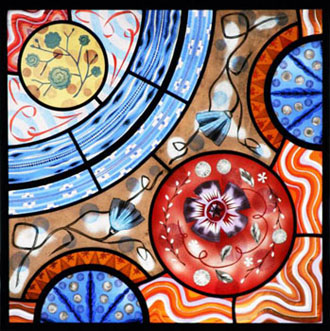
Karen Hibbs and Peter Burton - Stained Glass
In The beginning
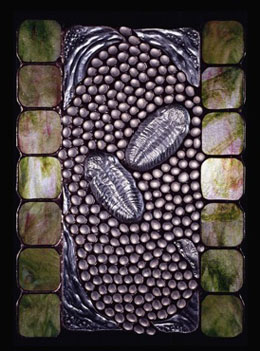
Alice Gebhart, Fused glass
I like the sketchiness of her work, especially as translated into fused glass.
Trilogy 3
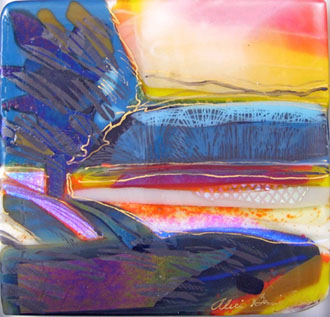
Best wishes to all and good sales in a tough economy!!
March 09, 2009
Blenko Resumes Partial Operation
From the Huntington Herald Dispatch - Blenko Resumes Partial Operation
We'll see how this plays out. There is still no mention of whether or not they go into bankruptcy, or whether they have an investor. Also no mention of what operations are being revived, stating only that the furnaces are getting started up again.
Also found this article from last September, Blenko's executive leadership shaken up, which is interesting in light of the recent events.
January 31, 2009
Blenko Closes?!
This is a shocker...
via the AGG bulletin board and huntingtonnews.net. -
By Tony Rutherford, Huntingtonnews.net Reporter
Huntington, WV (HNN) - One of the only hand blown and stained glass manufacturers in the United States has closed. Blenko Glass, a Milton tourist attraction, told workers Friday afternoon, Jan. 30, 2009 that production had stopped.
The company has an on-going dispute with Big Two Mile natural gas company and the two parties have not been able to negotiate any compromises.
About 50 employees will lose their jobs.
say it ain't so.
more from the news services -
Charleston Gazette - Blenko Glass stops production, perhaps for good
Huntington Herald Gazette - Blenko Glass to shut down
Charleston Daily News - Historic Blenko Glass shuts down
WSAZ news - Blenko Glass Stopping Production
Herald-Dispatch's Heart of Glass, a Blenko Glass related blog
Looks like this has been brewing for years, with lots of legal shenanigans. As a stained glass enthusiast, I can only hope it resolves itself without losing the glassblowing facility for good.
More info on the legacy of Blenko Glass at The Blenko Project.
Full press release below the fold -
The full press release from January 30, 2009
Blenko Glass Company, Inc.
P.O. Box 67.
Milton, WV 25541.
January 30, 2009.
For Immediate Release
Blenko Glass Company announced today that it is shutting down production and is discussing with its counsel whether it should consider filing for bankruptcy. The Blenko Visitor’s Center will continue to remain open. The Milton based manufacturer of hand made glass was sued by Big Two Mile, its former gas supplier, four years ago because of a disagreement about the payments due for gas used at the factory. A court found in favor of Big Two Mile and entered a judgment against Blenko for more than $500,000 in September of 2005. Several proposals for settlement of the case were made by Blenko; none of the proposals was accepted. Over the past three years members of the Blenko Family were in contact with members of the Maier Family who are the owners of Big Two Mile. Blenko was led to understand that Big Two Mile would not take steps to shut down Blenko. Relying on those assurances Walter Blenko of Pittsburgh PA and Don Blenko of Wellesley MA invested more than 2 million dollars in Blenko in an effort to return the company to profitability. In recent months the company’s losses had been reduced and Blenko management was looking forward to seeing a positive cash flow in the company’s operations. On January 15, 2009, Big Two Mile took steps to seize “all amounts, deposits, and moneys” in the Blenko Glass bank accounts including its payroll and withholding accounts. Blenko first learned of Big Two Mile’s action on January 23, when Blenko’s bank reported that the bank accounts had been emptied. Blenko had issued a check on that day to pay for gas that it used in its glass making furnaces. When Blenko learned its funds had been seized it was able to recover the check which was already in the mail. Because of nonpayment Blenko’s gas supplier has refused to supply gas for the glass making process after January 31, 2009. Blenko has therefore shut down its furnaces and some of them will be destroyed due to the loss of heat. Blenko employs approximately 50 employees. Walter Blenko, President of Blenko Glass, said “I want to thank and pay tribute to the many loyal employees of Blenko Glass who worked diligently and faithfully against bad economic conditions to keep the company operating and producing world renowned Blenko Glass up until the last day.” For further information please contact: Walter Blenko, President, or Katie Trippe, Assistant Vice President, at (304) 743-9081.
January 28, 2009
The Art of Collaboration:
Stained-Glass Conservation in the Twenty-First Century
via the email group Stained Glass Forum -
Registration is now open for the Forum for the Conservation and Restoration of Stained-Glass Windows, which will take place in New York City from 1-3 June 2009. The Forum is being held under the auspices of the American Corpus Vitrearum and the International Committee of the Corpus Vitrearum for the Conservation of Stained Glass.
The three-day conference will consist of two full days of oral presentations and poster sessions at The Metropolitan Museum of Art, one of the preeminent cultural institutions in the world. Evening receptions will be held at The Cloisters and in the newly renovated Engelhard Courtyard, which will allow participants to view some of the Museum's extensive holdings of European and American stained glass. The third day of the conference will be spent viewing stained glass in situ in Manhattan churches in the company of local experts. The day and the conference will end with a closing reception. The Forum will be preceded by a "Sunday at the Met" event – an afternoon of public keynote lectures devoted to general themes connected to the Forum.
The Forum is open to all interested stained glass professionals, including conservators, conservation scientists, architects, cultural heritage managers, art historians, students, etc. The venue is intended to provide an unprecedented opportunity for professionals from Europe and North America to meet and share their expertise and experience.
The theme of the Forum will be "The Art of Collaboration: Stained-Glass Conservation in the Twenty-First Century". Papers will be delivered in English, French and German with simultaneous translation. Texts of the oral presentations and summaries of the poster presentations will be published by Brepols Publishers in cooperation with the American Corpus Vitrearum.
Information about the conference, including a provisional list of presentations and the registration form is available at www.forum2009ny.org. Participation is limited to 150 on a first-come first-served basis, so early registration is encouraged.
My own 2 cents - Even though this is geared toward stained glass restoration professionals and scholars, and not toward the contemporary stained glass artist, any chance to be a part of a stained glass event that would feature 2 days at the Metropolitan Museum of Art, plus receptions at the Cloisters, The National Arts Club and a day tour of stained glass in New York must be of value to any stained glass artist. I suspect this will fill up fast.
January 21, 2009
Judith Schaechter in American Craft
Article in American Craft Magazine called Through the Looking Glass: Judith Schaechter’s marriage to her medium.
The article is both interesting and informative. Definitely check out the slideshow, and there is an audio interview at the bottom of the page that is definitely worth the 15 minutes or so of your time to listen to. From being on the panel with Judith at the American Glass Guild conference last year, I know that hearing Judith speak in her own words adds to the content of what she's saying. Not only does she do beautiful work, but she has a very unique and interesting take on the art of stained glass and on the world.
On a separate but related note, check out Judith's blog, Late Breaking Noose, as she's been doing a series of very interesting technical posts, like this Stained Glass Lesson and yet Another Stained Glass Lesson. Gotta get me one of those diamond files...
January 07, 2009
Dome of Light
Dome of Light, Kaohsiung Rapid Transit Corporation, in Kaohsiung, Taiwan. Designed by Narcissus Quagliata and fabricated at Derix Studios, in Germany.
It's big.
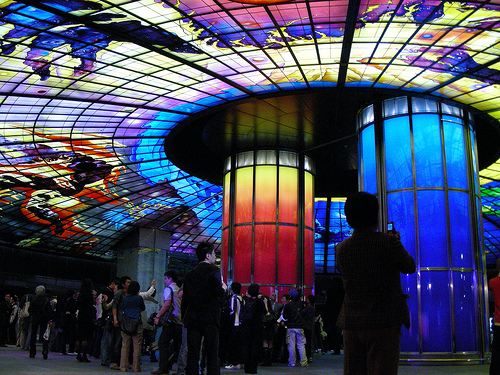
There are more pictures of and videos about the commission at Quagliata's updated website.
I've also posted a few comments with some flickr photos and YouTube videos below the fold, mostly from the unveiling and dedication from March, 2008
Dome of Light on Flickr
The best photos by far came in a search for 'Dome of Light' in Hiroshiken's Flickr Photostream. Very nice shots.
Like most of Quagliata's recent work, it looks mostly abstract but has representational images organically mixed in, like these dancing figures.
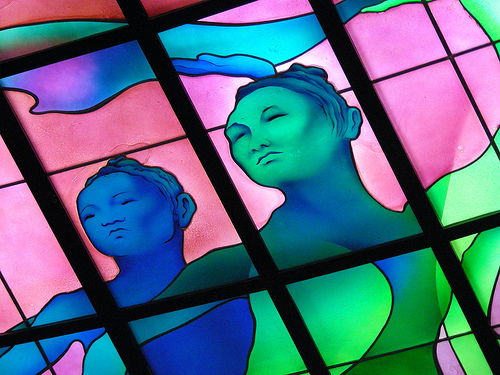
Quagliata has also been incorporating commissioned hand blown pieces, like these large rondel-like pieces.
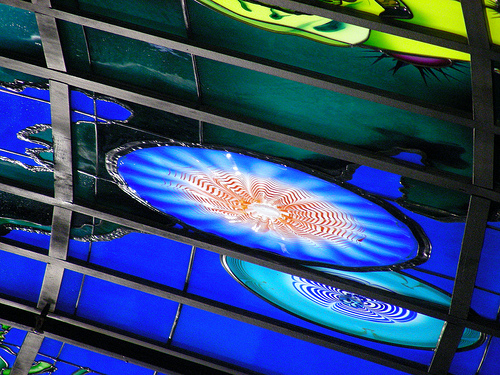
Closer in the same image, revealing some of the construction details.

You can also see some sense of the construction in this shot of the unlit dome.
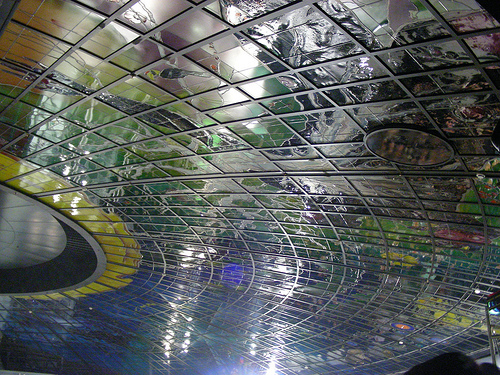
Compared to more or less the same shot with the dome lit.
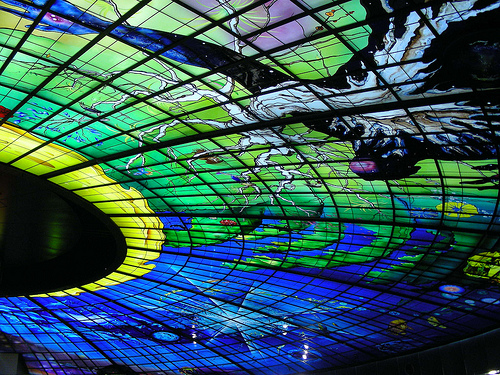
Dome of Light on YouTube
Surprisingly, there are quite a few different YouTube videos about the Dome of Light. Mostly of a crude and shaky quality, but a few are interesting enough to check out.
This looks to be the formal unveiling, which shows that the whole thing is artifically lit. That is one big light box.
This is my favorite, if only for the pure Chinese exuberance of it.
It's interesting that this commission has not generated much buzz here in the US. If it's been in any of the glass magazines or mentioned on forums etc, then I've missed it.
December 13, 2008
Nancy Nicholson in the 2009 Smithsonian Craft Show
Nancy Nicholson has been accepted for the 2009 Smithsonian Craft Show - check out the Nancy Nicholson exhibitor page.
Big news, as it's pretty rare for a stained glass artist to make it into the show. I was in the 2000 Smithsonian Craft show and it was a great experience, and I'm still getting commissions from that show.
Though they have no information on past shows online, my sense is that the Smithsonian Craft show accepts a stained glass artist only once every 2-3 years, at best. It's said that there is always a ratio of something close to 100 to 1 of entries to acceptances. So on top it being great for Nancy, it's also great exposure for stained glass as well.
Kudos and best of luck to Nancy!!
December 03, 2008
Judith Schaechter In Glass Quarterly
Interview with Judith Schaechter in the Winter 2008-09 / Issue 113 of Glass Quarterly. I haven't seen it yet, but the issue seems focused on the new Museum of Art & Design building, including Judith's commission.
She snagged the cover too.
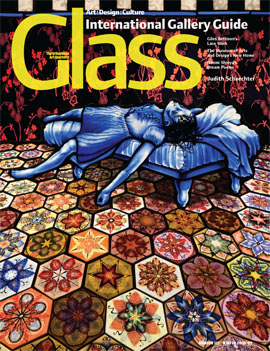
December 02, 2008
Connick - Article and New Book
Article in the Pittsburgh Tribune-Review on Charles Connick in Pittsburgh, coinciding with the publication of a new book on Connick called Charles J. Connick: His Education and His Windows in and near Pittsburgh by Albert Tannler, Historical Collection Director for Pittsburgh History & Landmarks Foundation.
Not related to Connick in Pittsburgh, but of interest to the Connick Studio enthusiast nonetheless, this is a preview of the documentary film, The Last Window, a documentary made just before the Connick studio closed shop in 1986.
I was living in Boston when the Connick Studio closed and the studio I was working for at the time helped in dealing with all the accumulated stuff. The Connick studio, at its close, occupied four floors of a building and there was decades worth of material to deal with. I'm still working off of some of the sheets and scraps of glass I obtained from their rows and rows of glass racks, and I only got a tiny fraction of what they had. I can remember whole crates of glass, opened but unused, dating from the 40's and 50's, just lying around.
The Connick legacy is represented by the Connick Foundation. It's a legacy worth preserving.
November 30, 2008
Dana-Thomas House Closes Due to Budget Constraints
An article (also here and here) announcing that, due to budget constraints, the state of Illinois is closing the Frank Lloyd Wright designed Dana-Thomas House, which is one of Wright's most significant sites in terms of its stained glass. (Wikipedia entry on Dana-Thomas House) The articles state that there are 250 pieces of 'art-glass' in the house.
this one from Flickrite lancer 617
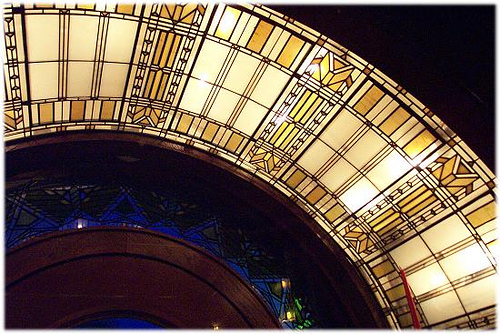
I hope they find a way to re-open this house. If there is one site that should be open as a prime example of Wright's use of stained glass, this is it.
[update April 17, 2009 - Good News! - Dana-Thomas set to re-open soon]
November 18, 2008
Russia Returns Stained Glass to Germany
Article called Russia Returns Stained Glass Windows to Frankfurt Church , about looted 14th century stained glass found in Russia and returned to Germany.
Noah's Ark window
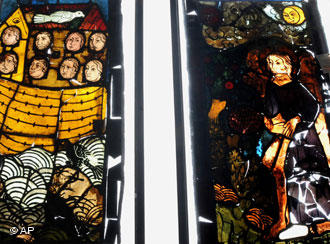
photo from deutsche welle
To see a few pictures from the BBC.
November 16, 2008
Judith Schaechter in the USA
Congrats to Judith Schaechter, who has won a 2008 United States Artist (USA) fellowship. As far as I can tell from a cursory look at the USA website, this is their first award to a stained glass artist - though I dare say it's a little ironic to categorize Judith's work under "crafts and traditional arts". More power to you, Judith. You deserve it, no matter what the category.
[update - Nov. 17, 2009 - Late Breaking Noose. no, not a typo, though it is late breaking news - actually, it's a new blog by Judith Schaechter. It's for "for updates on exhibitions, new work, teaching activities etc. I suppose I might also post the occasional rant and rave about whatever as well..." Good Luck and welcome to the blogosphere, Judith!]
November 11, 2008
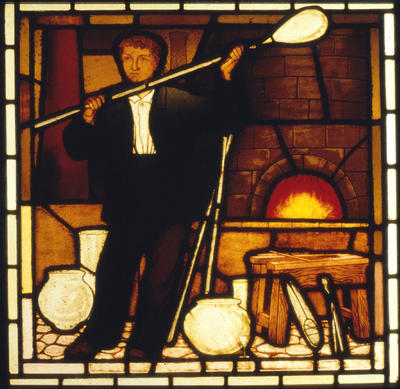
Stained Glass Returns to Burgh Halls
via the Mosaic Art and Glass Art blog - An article about stained glass being returned to Maryyhill Burgh Halls.
Make sure to check out the related gallery of 17 panels on TheGlasgowStory website.
They depict Maryhill workers and craftsmen at work, including...
The Glassblower, by Stephen Adam, circa 1878
For Maryhill Burgh Halls, Glasgow, Scotland
October 05, 2008
Tiffany at the Nassau County Museum of Art
A positive review in the NY Times today called Tiffany Times Two. The two exhibits reviewed are "Tiffany Lamps: Articles of Utility, Objects of Art" and "Tiffany and the Gilded Age", both at the Nassau County Museum of Art, in New York, on display until January 4, 2009.
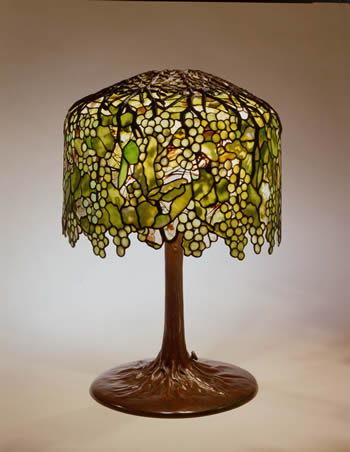
Grape Library Lamp
Tiffany Studios, Inc., circa 1900-1910
September 18, 2008
Wilhelmina Geddes Apollo Article
The first speaker I heard at the AGG Conference in August was Dr. Nicola Gordon Bowe, who spoke about Wilhelmina Geddes. Dr. Bowe mentioned at the conference that she has an article coming out about Wilhelmina Geddes in a future issue of Apollo Magazine. This week, I was pleasantly surprised to find the article is online - A Window With Punch.
Definitely worth checking out as it's a long article with images. The story involves a bit of controversy as well. Seems the new vicar didn't like the 'experimental' new window and had it removed to a less prominent part of the church, using rather strong language in the bargain, even referring to the 'hideous' and 'repulsive' St. Christopher carrying the 'Mongolian Christ Child'. Yikes.
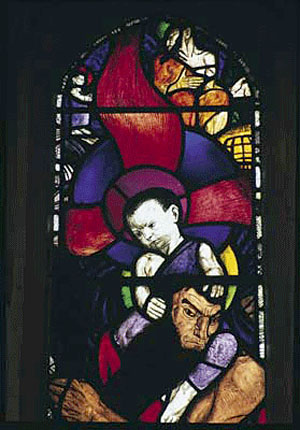
St. Christopher with Christ Child
Detail of window for All Saints Church, Laleham, Surrey , 1926
Photo: Peter Cormack
For more on Wilhelmina Geddes, we'll have to wait for Dr. Bowe's book on Wilhemlina Geddes to come out in 2009. Looking forward to it...
August 30, 2008
NPR - how to tell the economy is weak.
Duluth Sells Historic Window To Make Ends Meet, a segment on NPR's All Things Considered today about the city of Duluth, Minnesota selling a Tiffany window to raise cash for the government coffers. More details in the article, Can she save the city?, on the Duluth News Tribune website. At least one thing was factually wrong in the NPR report. Figural designs in Tiffany windows are not nearly as rare as was suggested by the Duluth representative.
The figure is of Minnehaha, the fictional character from the poem The Song of Hiawatha, by Henry Wadsworth Longfellow.

and a detail found on Flickr
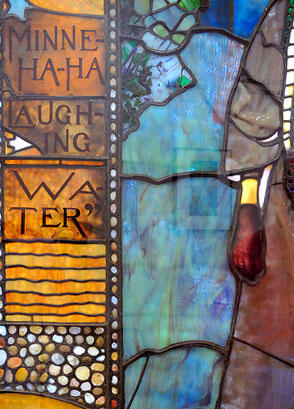
With him dwelt his dark-eyed daughter,
Wayward as the Minnehaha,
With her moods of shade and sunshine,
Eyes that smiled and frowned alternate,
Feet as rapid as the river,
Tresses flowing like the water,
And as musical a laughter:
And he named her from the river,
From the water-fall he named her,
Minnehaha, Laughing Water.
I've never read the full poem, but mainly know it from its many parodies. My favorite being Lewis Carroll's version, Hiawatha's Photographing.
[update October 7, 2008 - The New York Times picks up on the story and puts it in context with the broader economic situation - Financial Crisis Takes a Toll on Already-Squeezed Cities. Bonus for the SG enthusiast - they have an image of the full window.]
[update- Oct 16, 2008, good news - Duluth takes for sale sign off 'Minnehaha' window
]
August 23, 2008
Stained Glass as Nanotechnology??
Articles originating out of Queensland, Australia with titles like Gold nanoparticles purified air in old churches and Solar-Powered Nanotech-Purified Air In Medieval Churches and Stained glass windows painted with gold 'purify air' are hitting the news and blog sites for the past few days.
As much as I would like to see stained glass associated a with cool-sounding 'green'-oriented 21st century technology, I'm skeptical.
The glaziers who created gold-painted stained glass windows for medieval churches in Europe inadvertently developed a solar-powered nanotech air-purification system. According to Zhu Huai Yong, an associate professor at Queensland University of Technology in Australia, the gold paint used in medieval-era stained glass windows purified the air when heated by sunlight."For centuries people appreciated only the beautiful works of art, and long life of the colors, but little did they realize that these works of art are also, in modern language, photocatalytic air purifier with nanostructured gold catalyst," said Zhu in a statement.
Zhu said that tiny gold particles found in medieval gold paint react with sunlight to destroy air-borne pollutants like volatile organic chemicals/compounds (VOCs), which are emitted from paints, lacquers, and glues, among other things.
I won't pretend to even begin to comprehend the science behind this but there are some basic questions that come to mind. What are they talking about as the 'gold paint' in Medieval stained glass windows? Gold in the fired in paint? Gold in the glass itself? I've never heard of there being gold in stained glass paint, other than the rare occasional use of ruby enamel, which I always thought came into existence later than Medieval times. There is of course actual gold in pink glass - it's even called gold pink glass, but again that is rare and that would not be referred to as 'gold paint'. If there is a suggestion that gold was a trace element in fired in black paint in Medieval churches, it's news to me. Very puzzling.
It's a nice idea that stained glass has some hidden scientific or environmental benefit. I just want them to get the facts right.
August 14, 2008
NYC Subway Cityscapes
Article in the NY Times today called Set in Glass, Artist’s Ode to Bronx Life Is Acclaimed, touting the public art awards received for a series of stained glass panels designed by Daniel Hauber and fabricated in Dalle de Verre by Larry Gordon. There's also a NY Times blogpost about the same thing, with live links.
Mango Vendor
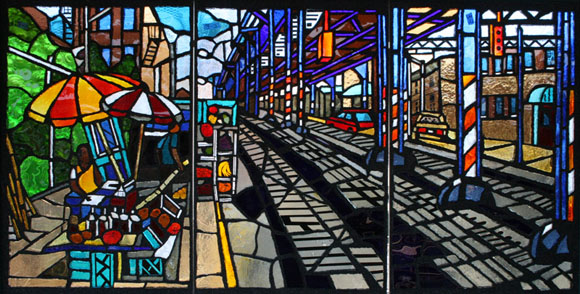
I like the way the black lines work into the shadows of the elevated rail.
The commission came from the surprisingly prolific Arts In Transit program in New York City. Check out the Permanent Art Section of the New York City Transit area and browse through the different commissions - a surprising number are in stained glass, almost always Dalle de Verre. There is some further background in a 1994 NY Times article called Raising Artistic Sights of Riders in Nether and Upper Regions.
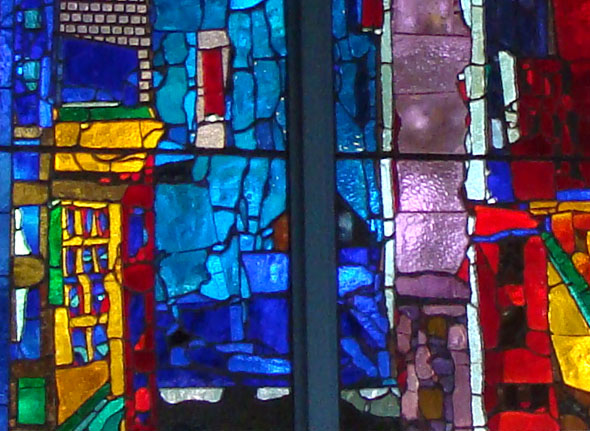
The idea of the subway cityscape reminds me of these great abstracted cityscape windows at The Westchester Square-East Tremont station on the No. 6 East Side IRT line in the Bronx. Designed by Romare Bearden and fabricated by Benoit Gilsoul and Helmut Schardt.
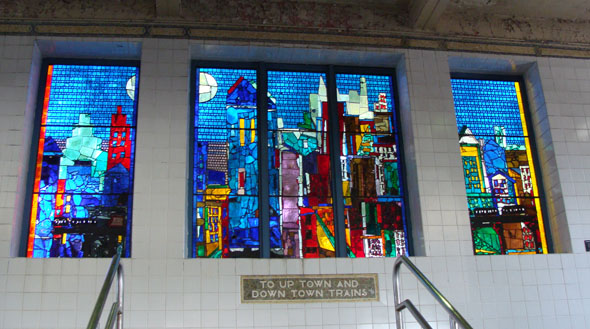
Here is the same photo magnified to show the undulating lines and the glassiness of the faceted glass. Very nice.
August 05, 2008
Garth whiffs Cologne
Garth at Extreme Craft blogs about "A Whiff of Cologne" - his visit to the see the Gerhard Richter Cologne Cathedral Window.
May 06, 2008
Many-Colored Glass in The New Yorker
This is a first. A 3,000+ word article about stained glass, called Many-Colored Glass, in the venerable magazine The New Yorker. It's written by Peter Schjeldahl about contemporary German painters Gerhard Richter and Sigmar Polke, and their individual forays into stained glass. Richter for the recently dedicated window at Cologne Cathedral, and Polke for the unfinished set of windows going into the Grossmünster, in Zurich, Switzerland.
It crosscuts between profiles of Richter and Polke, all the while interspersed with Schjeldahl's exasperated and slightly maddening history and assessment of stained glass. I've got to mull this one over before I comment further.
A technical note - the article does clear up one technical question about the Cologne window. As suspected, the panels were laminated and not fused. There would not have been the boasting about using handblown glass if they had been fused, as the fusing would destroy the texture of the handblown glass. My guess is that the individual panes of glass are sandwiched between two layers of plate glass.
Quick links for Gerhard Richter and the Cologne Cathedral window -
My previous posts on Richter's Cologne Cathedral Commission here and here.
Wikipedia entry for Gerhard Richter
Fun context - Cologne window as pixel art (SG about 3/4 down page)
Quick links for Sigmar Polke and the Grossmünster -
New York Times article from 2007 called The Alchemist's Moment
Wikipedia entry for Sigmar Polke
Wikipedia entry for the Grossmünster
Pictures of the Grossmünster
May 05, 2008
New Window - St. Martin in the Field
A favorable review by Rebecca Geldard in the Guardian, called New Window in St. Martin's Past, about a stained glass window by Iranian born artist Shirazeh Houshiary created as part of a mojor renovation and expansion of St. Martin in the Fields, in London, England.
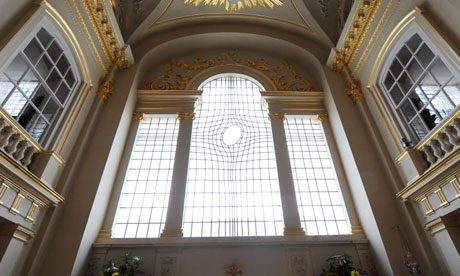
photo by Linda Nylind for the Guardian
Meanwhile, in another article in the Guardian, called New Look of St. Martin's, Jonathan Glancey praises the restoration in general but does not seem to like the stained glass so much, referring to it as the "one controversial note struck in the otherwise impeccable interior".
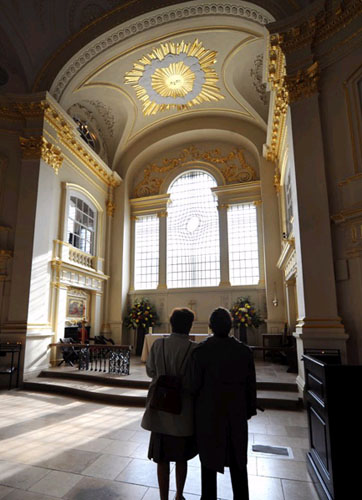
photo by Linda Nylind for the Guardian
Personally, I think the stained glass works remarkably well. Admittedly, my first reaction was that it's a bit minimalist for my taste. But looking over the images in context in the "New Look - St. Martin's" photo tour, it became clear that the design works beautifully for the space. Color, certainly bold color, would have been totally wrong for an 18th century classical space. The same with figural imagery. In terms of style, the question would be how to integrate with the classical 18th century surroundings while acknowledging that this is a new window. Most contemporary artists, when asked to do a commission like this, simply impose their own style, with the result looking jarring and disjointed. I do wish the Guardian had published all five commissioned designs when they were on display in 2006.
I imagine they did indeed make the best choice. It is impressive that Housiary working with Pip Horne, her architect husband, tried to balance the different aspects. A design that attempts to acknowledge the sacred space and also work within the design elements of the classical past while trying to make it clear that this is a new part of the church, and obviously from a design aesthetic of the present. That's not an easy balance, but it was handled well here.
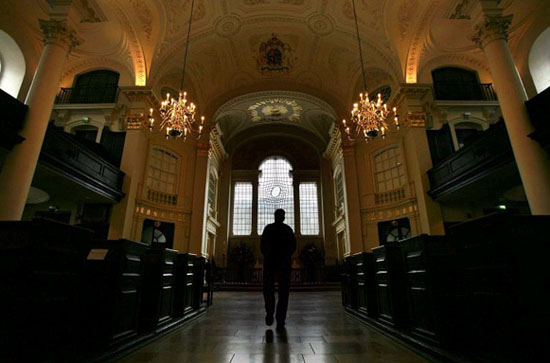
photo by Christopher Furlong/Getty Images
April 30, 2008
Stained Glass - on a License Plate
News today that Florida will likely not approve the idea of a Christian themed license plate.
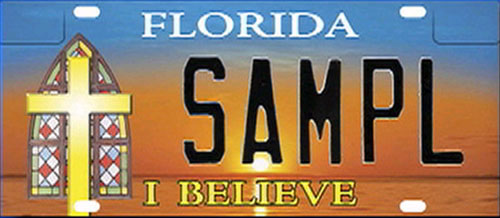
I'm more or less indifferent regarding the idea of a Christian themed license plate.
My problem is this - I don't like to see the image of a stained glass window used as a generic symbol for religion. I see it all the time, and I don't like it. If you must, think of it as my own call for 'brand protection'. I do not want stained glass shown as inherently or exclusively religious.
I was raised a Christian, specifically a Lutheran, but the particular church building I knew as a child did not have stained glass. My parents were not overly religious, neither were they interested in religious art, so we never made a practice of visiting other churches. Therefore, I never developed the notion of "stained glass equals religion".
I became interested in stained glass through the arts & crafts movement of the 1960's, specifically through seeing it for the first time at the Guilford Handicraft Festival, now the Guilford Craft Expo, in Guilford CT. Here, and for the 10 or so years after I first became interested in stained glass, I came across no subject matter specifically related to religion.
In the many years of working in the field of stained glass as a professional, I've grown to know, love and admire religious stained glass. I've met and known colleagues in the field who work in stained glass primarily because of their faith and I can respect that. I've worked on many religious stained glass windows in studios over the years, and have designed and fabricated some on my own.
Nevertheless, I still don't think of stained glass inherently, and certainly not exclusively, as a religious art. Instead, I see stained glass as a unique combination of materials and techniques that makes for especially striking, dramatic, colorful and beautiful artwork. I'm content with that.
I suppose my fear is that if more and more people associate stained glass exclusively with religion, the less stained glass will be seen as appropriate for public or commercial situations, or even for non-religious personal commissions.
I don't remember this practice of using the stained glass window as a generic symbol for religion being so pervasive 20 years ago. Was I just not noticing it as much then? Or am I just bothered by it more as I get older?
Whatever the answer, I say to Florida, if you must have a Christian themed license plate, fine - just please leave off the stained glass window.
Oddly enough, I came upon this story in yet another reference to stained glass on The Colbert Report. The world gets curiouser and curiouser...
| The Colbert Report | Mon - Thurs 11:30pm / 10:30c | |||
| The Word - Separation of Church & Plate | ||||
| ||||
[update, June 21, 2008 - Florida may not be doing it but South Carolina has approved the idea, inspiring even more satirical articles.]
March 25, 2008
CraftBoston and Providence Windows Project
The Boston School of Stained Glass gets busy -
This coming weekend - Friday-Sunday, March 28-30, 2008
Nancy Nicholson, Dan Maherand Kate Gakenheimer are all showing (and selling) their work at CraftBoston. It's unusual to see three stained glass artists in an upper echelon craft show. Nice to see.
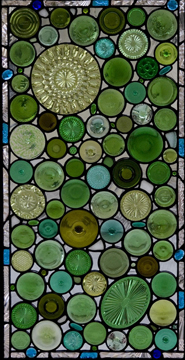
A bottle bottom panel, part of Dan's amazing Houseware Graveyards Series
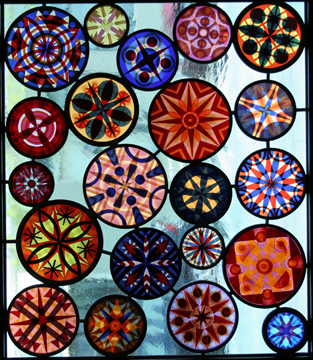
and this is one of Kate's dazzling pattern panels, inspired by Japanese Textiles.
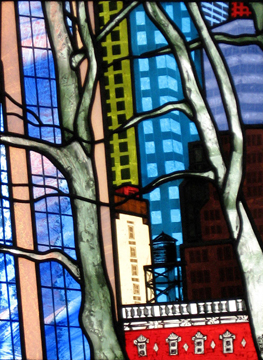
and one of Nancy's Cityscapes
Best of luck to them all. Sell Well!
Meanwhile, Alice Johnson and Kate Gakenheimer (busy woman) are displaying work at the Providence Windows Project.
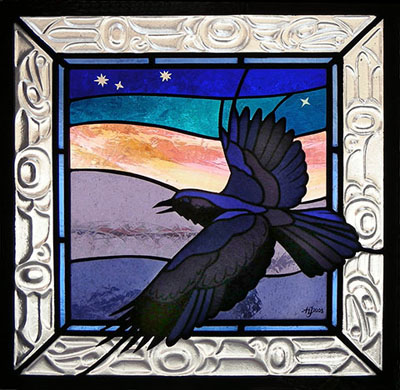
New Panel by Alice Johnson
February 21, 2008
Requiem for a Stained Glass Window
Just today, news from this AP article (and picked up by many sites like USA Today) announcing that the demolition of the Robert Sowers JFK Airport Window was started last week, ending in failure a long effort to save what was in its time believed to be the largest single stained glass window in the world.
You get a little more info at the rescue website called Save America's Window.
Curiously, I could find no other pictures than this on the web.
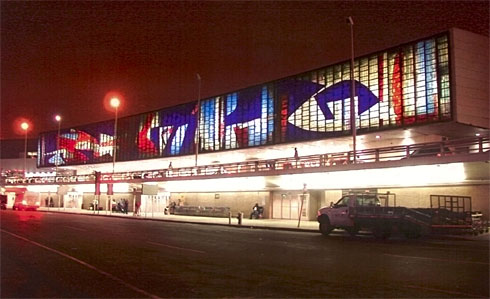
Sad, but not surprising, conclusion. We live in the age of planned obsolescence, or in this case, not-well-planned obsolesence. As much as the artistic and historical significance was acknowledged, the prevailing factors were space and money - too big and too costly to move as a whole. Plus, let's be honest, Robert Sowers is not exactly a household name. Well known within the world of stained glass to be sure, but not a mass market iconic name.
It's ironic that Ken VanRoenn is the one quoted in the initial AP article, since he is the first stained glass artist/architect I ever heard use the term 'economic life of a building', in a keynote address at a SGAA conference in 1992. He was making the point that stained glass studios, if they hoped to market their work in commercial, office or public buildings, would need to deal with the fact that the average economic life of a building is 35 years. I remember it sent chills down my spine, since this notion is not conducive to the traditional idea of stained glass, where the artwork is created for the ages, not the next 35 years.
I suppose there's some lesson I'm supposed to take away from this - vanity of vanities, all is vanity, etc, etc, blah, blah blah.
In any case, just do the best work you can and hope for the best.
[update feb 22, 2008 - New York Times article including pictures of workers dismantling the window. painful.]
December 19, 2007
A Glass Half Empty
An interesting and entertaining article, by arts writer Waldemar Januszczak, called A glass half empty at the National Gallery's Art of Light in the TimesOnline. It's a review of the 'Art of Light: German Renaissance Stained Glass' exhibition at London's National Gallery. I should note that it's a mostly negative review of the exhibit though tempered by an enthusiastic rave about stained glass.
just one among a number of curious kernels of thought -
... His contention was that stained glass avoids the brain altogether and appeals directly to the nervous system. In other words, you can’t help feeling what you feel in front of coloured glass. It doesn’t matter if the artist who made it is good or bad. When light passes through glass, it does something to you.
By way of contrast, here is another, more straightforward, review of the exhibition. This one has a number of images from the exhibit...
...including this one of the Tobias and Sarah panel described by Januszczak in the TimesOnline article.
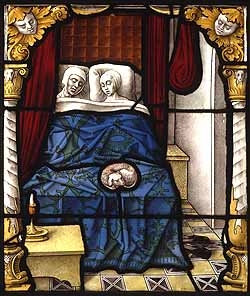
German (Lower Rhine), Tobias and Sarah on their Wedding Night, about 1520. © V&A Images/ Victoria and Albert Museum, London
And one more article, this time by Jonathan Jones in the Guardian. He muses about the limited value of showing stained glass in a museum setting. He has a point. There is nothing like natural light.
November 01, 2007
2007 Orin E. Skinner Annual Lecture
The Charles Connick Stained Glass Foundation hosts an annual lecture. This year it's on Monday, November 5 at 6:30 p.m. at Moseley Hall, Church of the Advent, 30 Brimmer Street, Boston. The speaker is Mark David Baden, Ph.D. Title of lecture: "We Met in a Crypt." Subject of lecture: the windows by Connick in Nazareth Hall, Northwestern College, St. Paul, Minnesota. The windows in Nazareth Chapel date from 1923-1925, which is when the Connick Studio was in its prime. I also noticed that the full program of windows at Nazareth are by Connick - a rare treat.
Samuel window, Nazareth Hall, Northwestern College, Minnesota
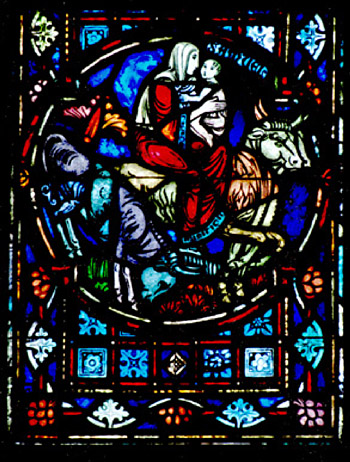
(photo by Brian Tanning)
May 02, 2007
TIME warp
It's unusual to see a print magazine fully archive their articles on the web and doubly unusual to see a print magazine archive pre-web articles on the web. That's why it's so strange to see this article on the web about stained glass, called Stained Glass, Back and Blooming, originally published by TIME magazine in March of 1978!
The funny thing is that I very well remember this article when it first came out. It was quite something at the time that a 'major news weekly magazine' was recognizing stained glass. I remember the photo shown with the article (not shown on the website) of a Ray King window - abstract, sort of Schaffrath-lite. This came on the heels of the relative success of the book "New Glass", and a number of the artists in that book are in the TIME article. I was a teenage stained glass hobbyist less than 2 years away from my first professional job in stained glass and it was nice to see stained glass getting some ink in a well circulated magazine.
All in all, a curious flashback.